May 25. High Portinscale in Lake District to Marriot near Heathrow
Saturday, May 25. Driven to Keswick bus stop by owner of our cottage (Judy). Bus to Penrith. Train to London Euston Station. “Tube” to Paddington Station. Heathrow Express train to Heathrow (Terminals 2 and 3). Walk to Heathrow Central Bus Station - then free Heathrow bus to the Marriot.
“Give way” suggests for me empowerment and generosity - with lovely associations to Native American give-away ceremonies that have always seemed wise and inspiring to me. “Yield” on the other hand associates to being pinned down by an opponent who demands that I say “uncle” (I wonder where that usage originates) and stirs up my resistance, my determination to be forever unvanquished.
The day of travel - and finding our way to and through unfamiliar train stations and ticketing arrangements - was exhausting. We decided to eat at the restaurant here in the hotel, which as it turned out had an Italian flavor. Chris was happy to choose Nero d’Avalo as our wine - a wine that stirred wonderful memories of last year’s Sicilian adventure (photo 3).

That’s enough for now. Tomorrow we will go to Heathrow in the morning. Judy heads for San Francisco at 10:30am and an hour later Chris and I head toward Denver. She will go on from Denver to Seattle, but I will stay in Denver, visit a day or two with friends Doris Hellinghausen and Robert Minnis (connections that have their roots in our high school years in Oklahoma City) and then head for Grinnell, Iowa, and my 50th college reunion (Class of 1969).
Dear Trail Friends,
I can’t say that bus and train rides or the return to urban crowding are my idea of true bliss. But I will say that the kindness of strangers - our ability to ask for help and their readiness to give it - was for me a very sweet spot in an otherwise not so beautiful day. Not even the weather was as good. After the prediction of a week of rain it was truly amazing to get as much sun as we did - and to really not take a minute of it for granted.
Judy, who was the manager of a customer service department much of her working life, says the secret to good customer service is to create very low expectations and then exceed them. That’s, she said, what the weather gave us this week: great customer service.
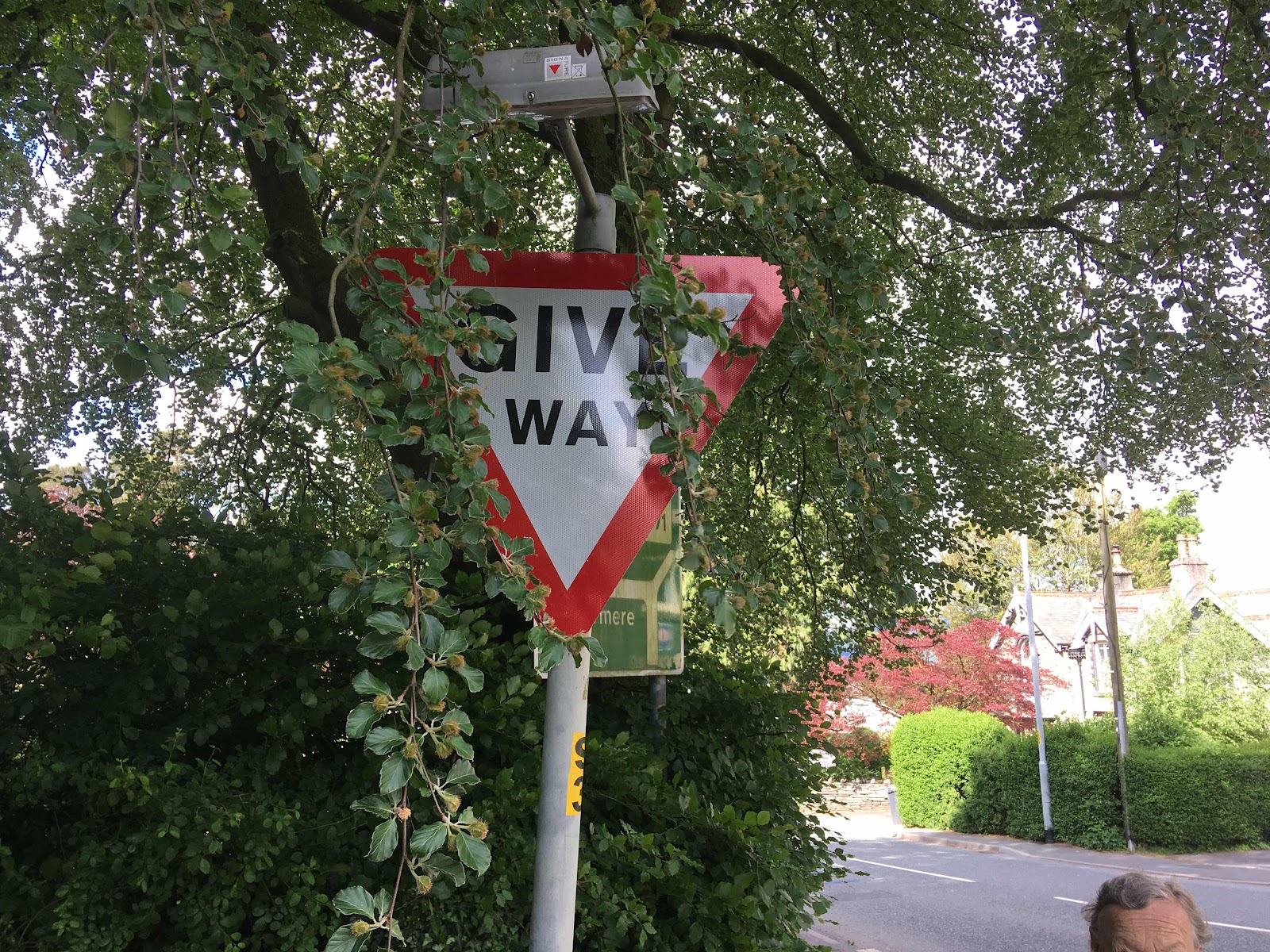
I have been enjoying some of the small differences between the English language spoken here and that spoken in America. Of course the music - the melody, rhythm, intonation - is entirely different and with my hearing loss it is difficult for me to understand. And then there are differences in how words are used. For example, I love the road signs that say “Give Way.” (Photo 1). They mean exactly the same thing as our “Yield” signs do and yet they affect me entirely differently.
“Give way” suggests for me empowerment and generosity - with lovely associations to Native American give-away ceremonies that have always seemed wise and inspiring to me. “Yield” on the other hand associates to being pinned down by an opponent who demands that I say “uncle” (I wonder where that usage originates) and stirs up my resistance, my determination to be forever unvanquished.
Since I know one of my major character defects is a need to get my own way in all things ( and even, I’ve been noticing on this trip, a need for others to be pleased by my way), I think that “Give way” could be a useful mantra for me. It is interesting how even minor nuances of language can open up new ways of seeing things.
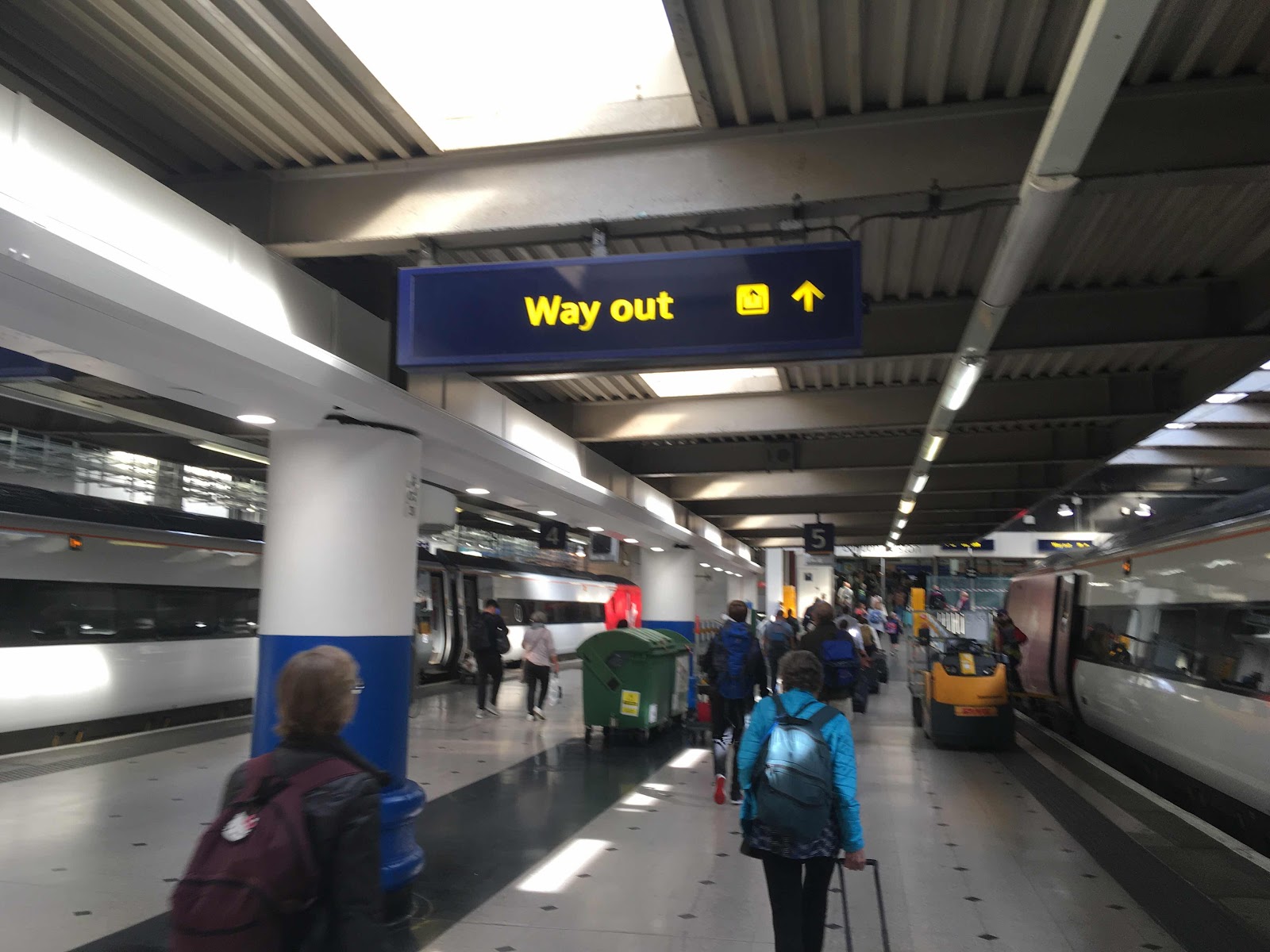
Just pointed out in the train station that instead of “exit,” the signs said “way out.” Since “way out” in American English means (what does it mean, really? I had to check the internet for a definition: extremely unconventional, unusual, or avante-garde. I like the idea that signs all over London Euston Station today were pointing us in extremely unconventional, unusual and avante-garde directions. (Photo 2).
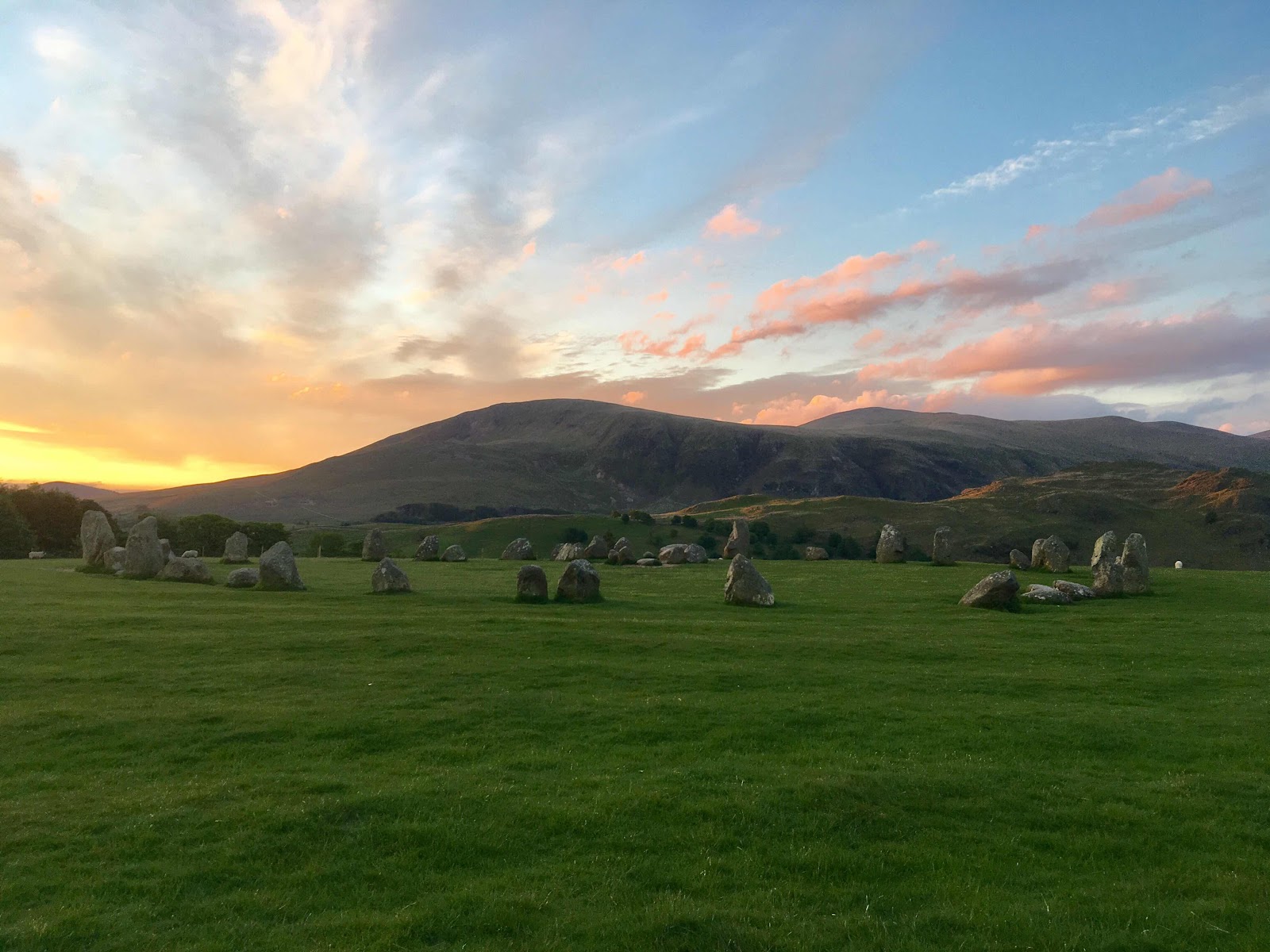
The day of travel - and finding our way to and through unfamiliar train stations and ticketing arrangements - was exhausting. We decided to eat at the restaurant here in the hotel, which as it turned out had an Italian flavor. Chris was happy to choose Nero d’Avalo as our wine - a wine that stirred wonderful memories of last year’s Sicilian adventure (photo 3).
That’s enough for now. Tomorrow we will go to Heathrow in the morning. Judy heads for San Francisco at 10:30am and an hour later Chris and I head toward Denver. She will go on from Denver to Seattle, but I will stay in Denver, visit a day or two with friends Doris Hellinghausen and Robert Minnis (connections that have their roots in our high school years in Oklahoma City) and then head for Grinnell, Iowa, and my 50th college reunion (Class of 1969).
I have just begun reading the assigned “homework” for the alumni college lectures, beginning with an article on Goya’s series of etchings titled “The Disasters of War.” The article describes how the drawings use space and point of view and facial expression to examine the role of onlooker, witness, and judge in human cruelty - and to engage the abserver of the artwork in those roles. The article explores Goya’s reflections on the Inquisition tortures, the brutalities of the Napoleonic war against Spain, and the brutalities of the war that drove Napoleonic forces out again. It reflects on Goya’s way of showing how victim can become brutalizer, and vice versa.
As I read the article I kept remembering the end of the MacBeth opera at the Vienna Opera House - the people (who in the libretto are seen pretty much as the good guys restoring order and decency) looking at their hands and trying to rub off the blood. I was struck by what seemed to me to be an extraordinary innovation by the director that added depth to the text. The idea that the ones righting the wrong had more in common with the wrong-doers than might be expected: the blood on their hands. It also suggested that the blood shed never stops. It goes on and on and on, and the blood on the hands leads people to commit more murders.
So .,. The “trail” tomorrow leads to Denver and if I’m lucky some walks in or near the great Rocky Mountains. Then on to Grinnell and a chance to reflect on that time in my life and perhaps to see it from a fresh perspective.
See you on the trail.

We’re in Denver now and fly out tomorrow morning. :)
ReplyDelete