May 9-10. Vienna
Thursday and Friday May 9-10. Walking Tour of Freud’s Vienna and Leopold Museum.

I was struck by the difference in skin color - the greenish tint of the skin in the reflection makes me think of a corpse and of death. I was also struck by the mask in the reflection. To my eye, the woman in front of the mirror was not wearing a mask. I was fascinated by the possibility that the painting was about life and death: the living self looking the dead self in the eye, yet the dead self masked and mysterious. (I’m sorry, I don’t remember the artist’s name).

This was interesting to me because most of the people on the life side seem to be sleeping, and only two have their eyes open. The death’s head seems to be looking at them, but they do not return death’s gaze.
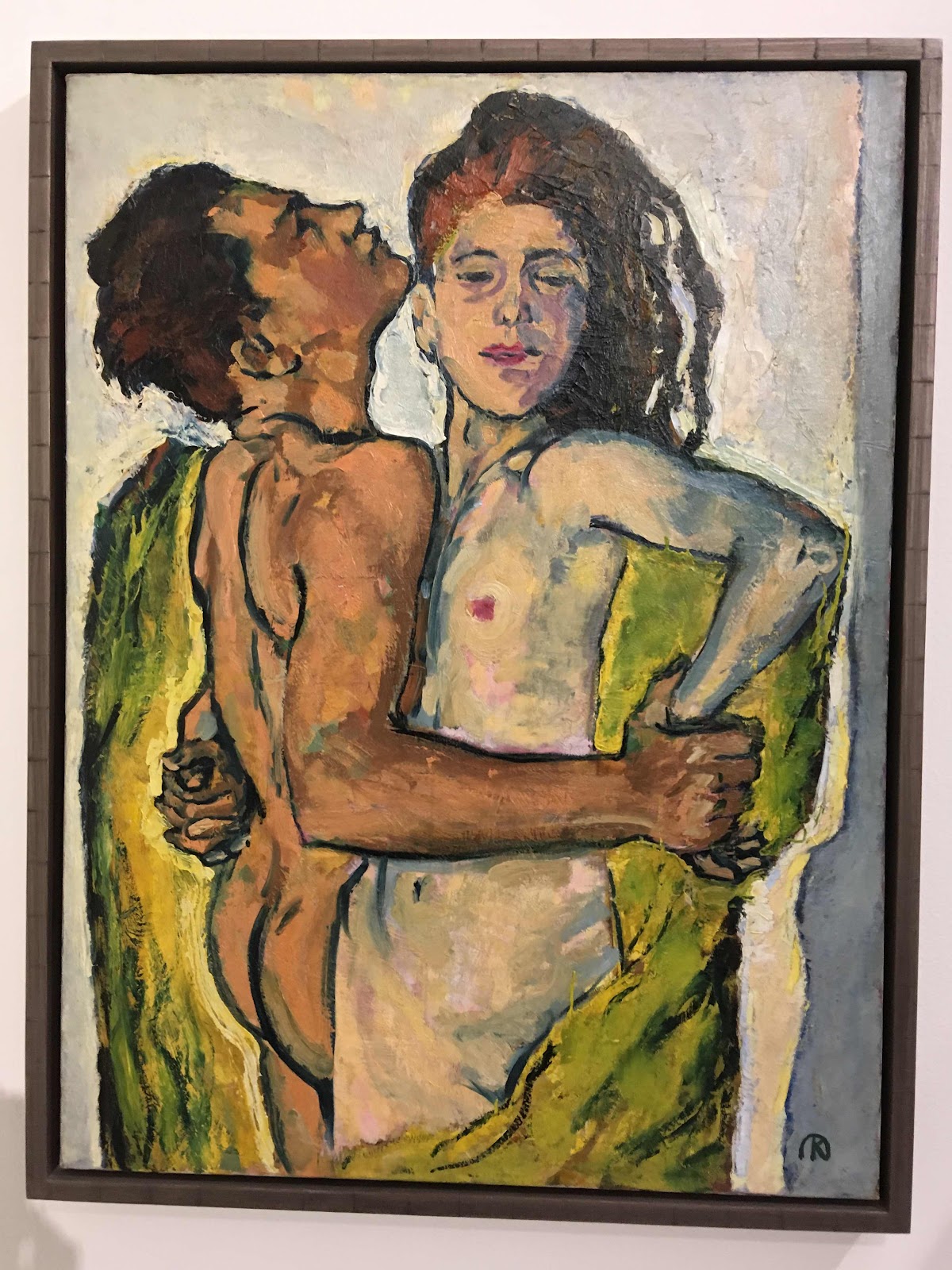
An interesting aside - though I don’t remember the artist’s name - was that this was originally painted recumbent and then the artist decided to sign the bottom and make it upright. I think the changed orientation makes the woman stronger and more “other. “
I find myself associating to Chris’s lecture last night in which she quoted several of Freud’s patients describing their experience of analysis and went on to describe the evolution of his technique from hypnosis to free association and interpretation to examining the transference. She spoke particularly of the chair placed so that the patient on the couch could not see the analyst. The accounts mentioned the silence - sometimes whole sessions in silence (which James Strachey describes as resistance that he could feel physically as if it sat on his chest and prevented speech) - and seemed to emphasize the patient’s encounter with the silence and otherness of his/her own self, in part because of the analyst’s distance.

I loved the detail of the mother and boy baby (from Klimt’s life and death) and having Chris and Peter (her first child) in front of the poster. It reminds me of how her interest in psychology began as she told us in an earlier lecture when she gazed into the eyes of this beautiful baby who had just days before been a part of her own body and was fascinated by the mystery of his otherness. What might be going on inside this tiny human being’s mind?

I had thought I would draw a variation of a drawing of a woman talking to death (photo 7). I absolutely love the way (unlike the lovers, and the analyst hidden out of sight behind the couch, for example) this particular skull and living woman seem totally engaged with each other.

This also reminds me of a painting of Salome holding the head of John the Baptist in which she seems to be in deep communion with the head. (Photo 7a). This makes me think of Freud’s thinking about the deep connection between love and hate, and how murderous urges and longing for love (and merger) can coexist.


I am writing this on Saturday morning sitting by myself at a breakfast table. I am uncomfortably aware of the bliss of my self-absorption as I write about otherness and the (I fear) abrupt way in which I dismiss anyone who has the audacity to greet me. Here I am wanting to share and reflect on this journey and wanting my inviolate solitude. What a bundle of contradictory needs we humans are. What I appreciate about Freud is the way he seems to hold all of that, and accept it, and bless it.


Because the actual museum (in the Freud home and office at Berggasse 19) was being renovated (for safety and to accommodate the large number of people who visit) it was closed and under construction. We visited a temporary site and our guide managed to get us through the scaffolding to the base of the stairs for which we were grateful. I was touched that the waiting room furniture was given to the museum as a gift from Anna Freud (If my memory is right).

Time to stop. Thank you for walking with me. See you on the trail later today and tomorrow.
Dear Trail Friends,
These two days in Vienna were so rich that I cannot begin to do them justice. But if I can give you even a small glimpse of them I will be delighted. I think I will start with an painting of a woman in front of a mirror from the Wien 1900 exhibit at the Leopold Museum. (Photo 1).
I was struck by the difference in skin color - the greenish tint of the skin in the reflection makes me think of a corpse and of death. I was also struck by the mask in the reflection. To my eye, the woman in front of the mirror was not wearing a mask. I was fascinated by the possibility that the painting was about life and death: the living self looking the dead self in the eye, yet the dead self masked and mysterious. (I’m sorry, I don’t remember the artist’s name).
There seemed to be a lot about life and death in the Leopold exhibit. Here is “life and death” by Klimt (Photo 2).
This was interesting to me because most of the people on the life side seem to be sleeping, and only two have their eyes open. The death’s head seems to be looking at them, but they do not return death’s gaze.
I was also struck by a number of paintings of lovers that seemed to me to accentuate otherness and perhaps discordance. In photo 3, the man with closed eyes seemed utterly absorbed (though perhaps self-absorbed) while for me there is something fierce and thrusting in the woman’s pose and her gaze is outward away from him and the two of them.
An interesting aside - though I don’t remember the artist’s name - was that this was originally painted recumbent and then the artist decided to sign the bottom and make it upright. I think the changed orientation makes the woman stronger and more “other. “
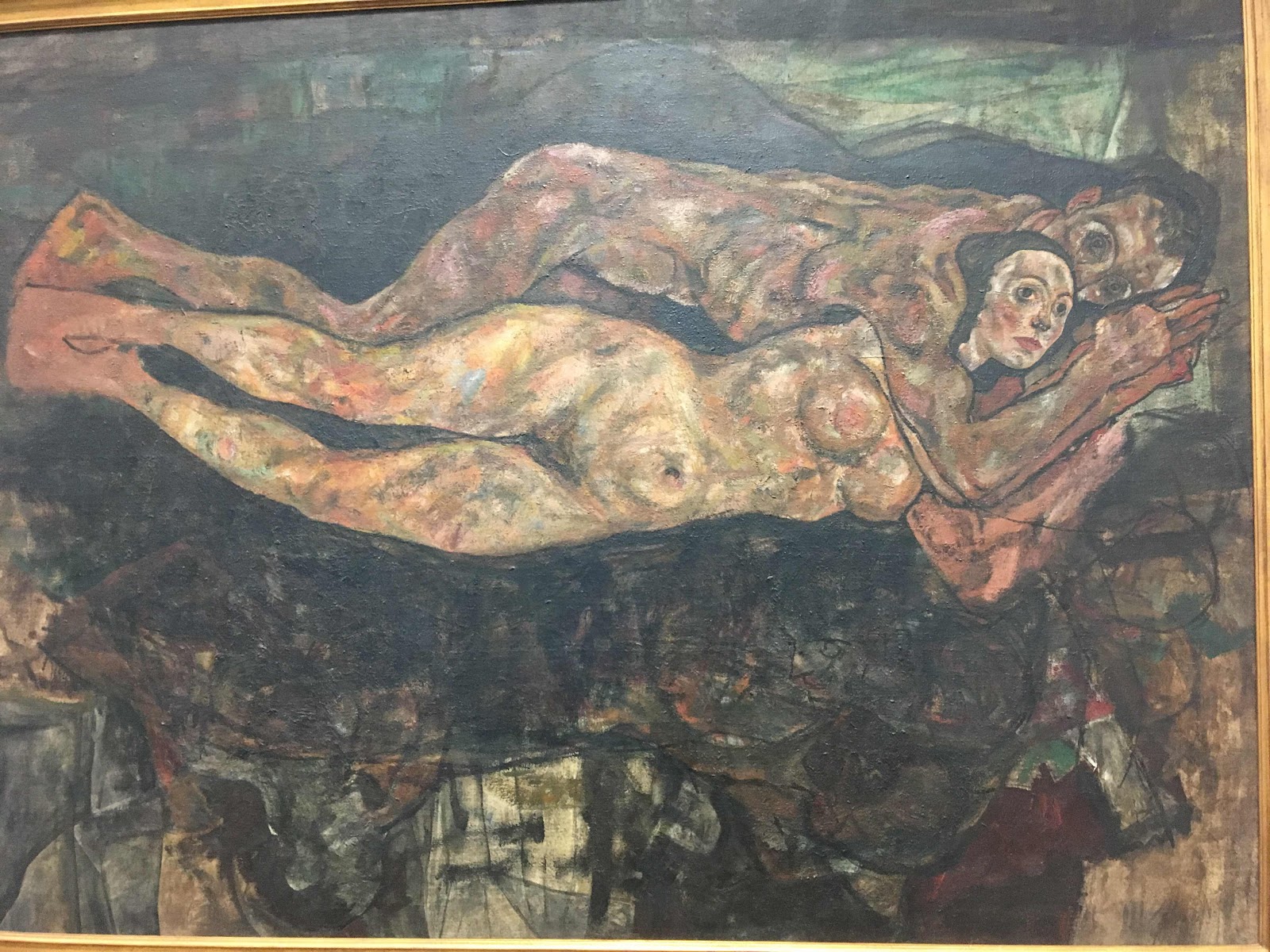
Photo 4 shows a couple I also found in some way emphasizing otherness. The man (and this is a self portrait of the artist with his wife) meets the gaze of the artist or onlooker. But the wife’s gaze seems directed elsewhere.
I find myself associating to Chris’s lecture last night in which she quoted several of Freud’s patients describing their experience of analysis and went on to describe the evolution of his technique from hypnosis to free association and interpretation to examining the transference. She spoke particularly of the chair placed so that the patient on the couch could not see the analyst. The accounts mentioned the silence - sometimes whole sessions in silence (which James Strachey describes as resistance that he could feel physically as if it sat on his chest and prevented speech) - and seemed to emphasize the patient’s encounter with the silence and otherness of his/her own self, in part because of the analyst’s distance.
This is just a little playful way of exploring the connection between Freud and other creative people in Vienna at the turn of the century. All of this was swirling around in my mind as I walked through the Leopold, mostly in a primary process preverbal way. Photo 5 shows Chris and Judy and Peter in front of the poster for the exhibit. It was fun for us to have Freud’s portrait part of the exhibit.
I loved the detail of the mother and boy baby (from Klimt’s life and death) and having Chris and Peter (her first child) in front of the poster. It reminds me of how her interest in psychology began as she told us in an earlier lecture when she gazed into the eyes of this beautiful baby who had just days before been a part of her own body and was fascinated by the mystery of his otherness. What might be going on inside this tiny human being’s mind?
Judy’s drawing (photo 6) for our day at the Leopold was inspired by the mother and baby - and by conversations about mothering and mothers who were relatively un-mothered and wounded in their ability to mother (including our own).
I had thought I would draw a variation of a drawing of a woman talking to death (photo 7). I absolutely love the way (unlike the lovers, and the analyst hidden out of sight behind the couch, for example) this particular skull and living woman seem totally engaged with each other.
This also reminds me of a painting of Salome holding the head of John the Baptist in which she seems to be in deep communion with the head. (Photo 7a). This makes me think of Freud’s thinking about the deep connection between love and hate, and how murderous urges and longing for love (and merger) can coexist.
But in the end it was the otherness of a cat (and my own faraway and beloved kittens) that engages my gaze more than death. Photo 7 shows my drawing and the painting that inspired it. I commented to Judy “of course I can’t get the cat in this drawing to be the way I want it to be - it’s a cat.”
I am writing this on Saturday morning sitting by myself at a breakfast table. I am uncomfortably aware of the bliss of my self-absorption as I write about otherness and the (I fear) abrupt way in which I dismiss anyone who has the audacity to greet me. Here I am wanting to share and reflect on this journey and wanting my inviolate solitude. What a bundle of contradictory needs we humans are. What I appreciate about Freud is the way he seems to hold all of that, and accept it, and bless it.
Our walking tour of Vienna was a delight but I’m not sure I remember any of the moments that I loved (a good reason to write this blog daily - but I am often too tired to manage it).
Photo 8 shows our group walking through a rainy Vienna (which somehow felt perfect for the tour).
Photo 9 is a collage from the tour: our lively guide Klaudia on the right in the photo in the upper left, Chris at the steps at Berggasse 19 on the right, a reconstruction of Freud’s waiting room in the lower left, and a monument to Freud in a park honoring him in the lower right (our guide translated it: reason speaks in a faint voice).
Because the actual museum (in the Freud home and office at Berggasse 19) was being renovated (for safety and to accommodate the large number of people who visit) it was closed and under construction. We visited a temporary site and our guide managed to get us through the scaffolding to the base of the stairs for which we were grateful. I was touched that the waiting room furniture was given to the museum as a gift from Anna Freud (If my memory is right).
An interesting note - we learned that the Freud home and office were one of the Jew houses, the collective homes that Jews were crowded into before being deported. This little bit of history of the place where Freud lived and worked feels important. Also that many of the Jewish women who were his patients lived within a few blocks, in the same neighborhood. It was a small world we walked through: not only the place where so many of his patients lived, but also the hospital where he researched and dissected corpses, the university where he became a professor, the cafe he visited frequently.
Friday afternoon was an orgy of frustration and thwarting - always a part of travel and when I think about it, part of any encounter with the unknown. (I am thinking of Strachey describing analysis as sometimes exhilarating and sometimes utterly frustrating. Not unlike travel.) I had bought a SIM card on our first day in the Netherlands and repeatedly tried to negotiate the website which was of course in Dutch. The only support was online chat and people tried hard to help me but I kept getting cut off. So I spent the entire afternoon buying a “top off” for my account at a newsstand only to discover it would not work and was non refundable. At long last I persuaded a woman from the chat to call me, and help me navigate the website. After we struggled together for a long time she told me I had tried so hard, she was just going to give me the added bundle for free. That moment of human kindness made the whole afternoon feel different. Like the sun breaking out and shining on the wet melancholy world.
Last night Judy and I did our contemplative drawing after the 6 pm lecture (because I had gone back to the leopold museum in the afternoon and barely got back in time for the lecture). So we ate a late night supper in the hotel restaurant, by then almost empty, and happened to have a conversation with the waiter. He told us he was from Hungary (so of course speaks three languages, Hungarian his mother tongue and German and English) and that he and his wife drive back every week to visit his parents who still live there. It’s hard to explain why this simple human encounter was one of the high points of my day but it was. I have also loved the moments in which I have been able to have conversations with tour mates beginning with “Where did you grow up?” Or “What brought you to Pacifica?” Or “how did you get interested in Jung?” (Because even though this is a Freud tour the tour group participants are drawn from Pacifica and the Jungian world). Everyone has a rich story and I am struck when people like Toni our tour guide or Chris (who teaches at Pacifica and lived eight years in the Czech Republic, so helped us enormously with his ability to speak Czech) talk about Jung in their lives they light up and talk about how they have been called in their life to their passions or as Campbell would say their bliss and how the way has opened for them and how lucky they have been. It gives me a fresh perspective on Jung and how his personality and ideas ripple through peoples’ minds and lives. I wonder if I when I tell the story of how I got interested in Freud I light up - or if the presence of soul is of a different kind? I do think my psychoanalytical work with my imagined Freud opened the way to my long distance hiking, which certainly involved passion and joy and luck and having the way open before me almost magically.
But strangely and contradictorily (I think of how Freud’s way of analysis involved not seeing the analyst and confronting the patient with her/his own solitary self) Freud was for me a very present “other.” I felt loved and accepted by him but also seen without mercy, without prettification, and that he honored me by extending his Jewish gift for self-deprecating humor to include gently mocking me and teaching me to laugh at myself.
I need to end this, although I am omitting the amazing lunch and conversation I had with a college class mate I had not seen for more than 50 years which I would love to include if I had more time and energy. I feel sad too not to have given you a taste of the pleasure of walking the streets of Vienna. I will end with at least a glimpse of those streets by sharing a collage of the views (left, center and right) from our garret room on top of the Hotel Regina.
Time to stop. Thank you for walking with me. See you on the trail later today and tomorrow.
For all the fatigue and bus rides, you still captured so much both in words and images. I especially like that drawing/painting is part of the pilgrimage. A multi-media feast. These are all fun and provocative to read. Dennis
ReplyDelete