April 29 - May 1. Den Haag to Cologne Germany
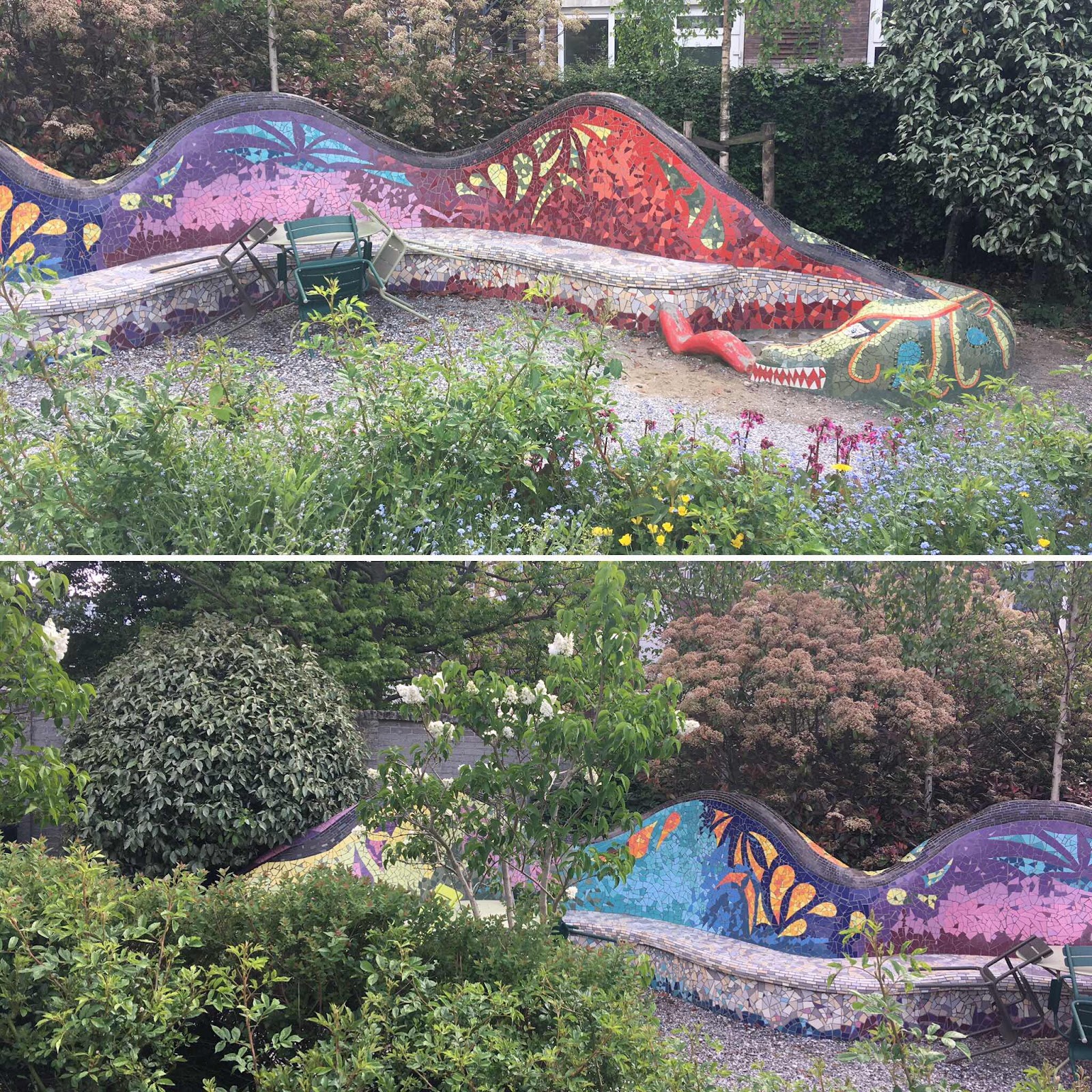
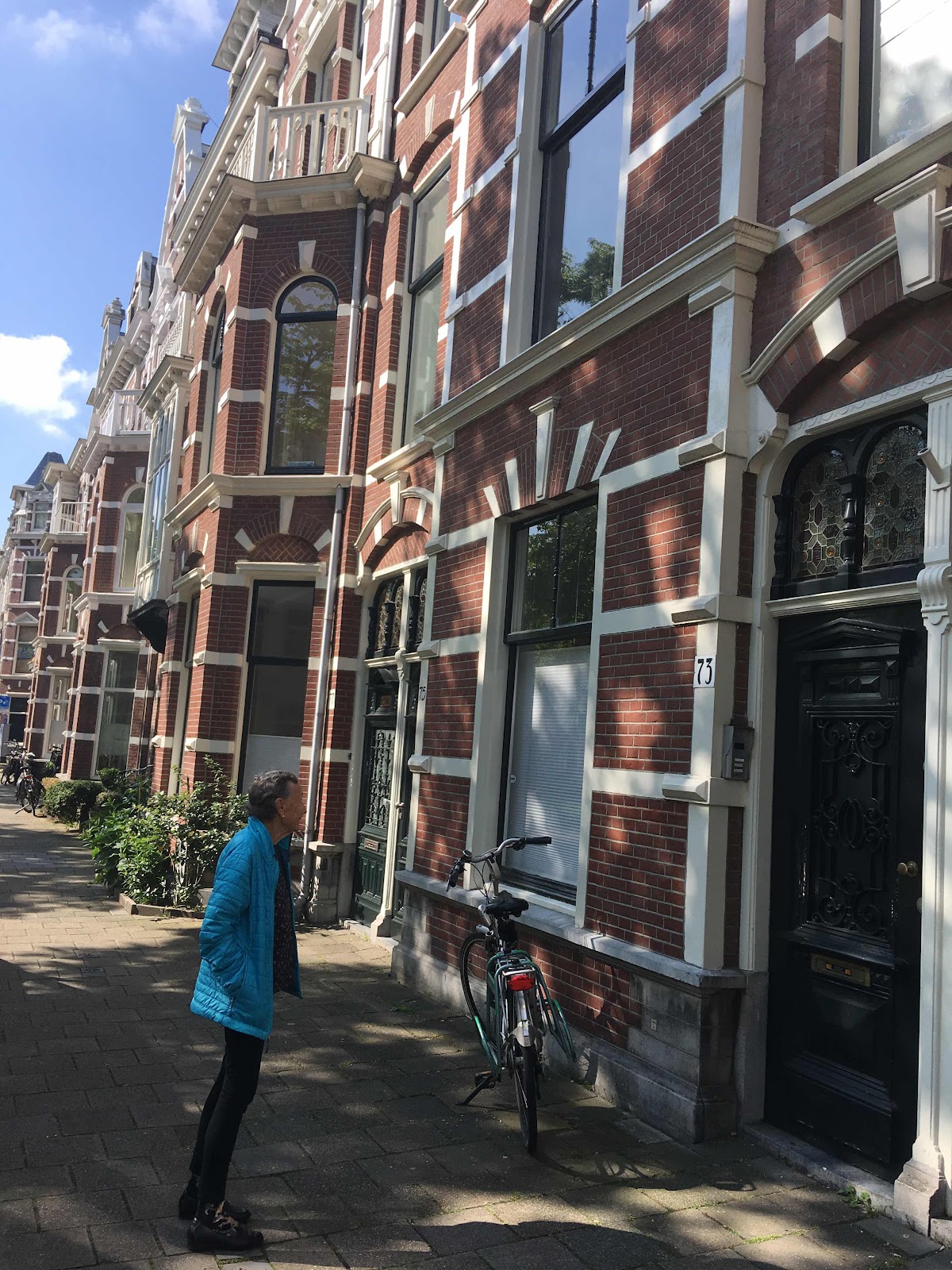
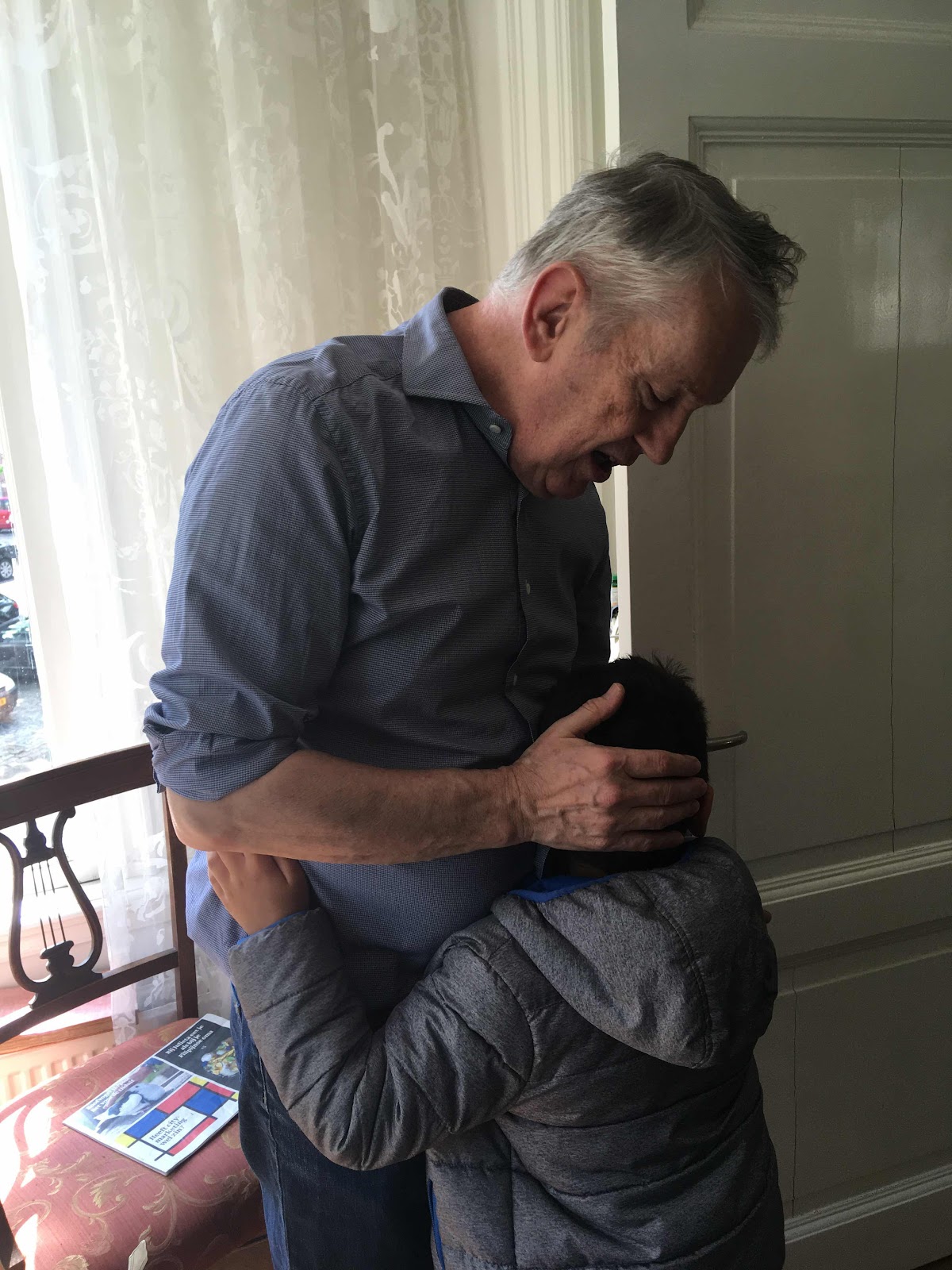
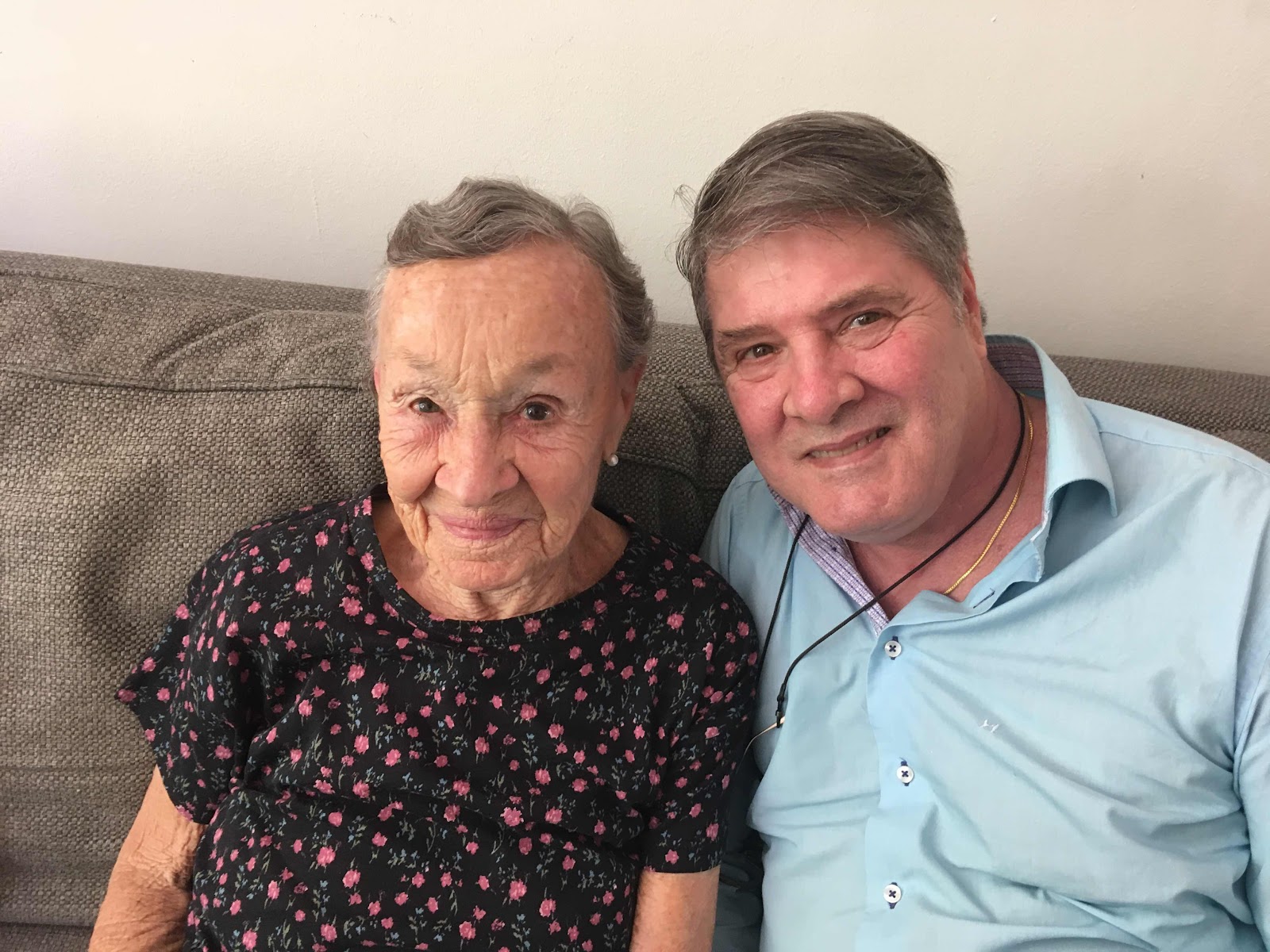
Photo 2 shows Chris in front of Jan and Christopher’s house, photo 3 shows Jan with his young friend Samuel (for whom Jan is a kind of grandfather figure) who lives with his father on the third floor of their house and photo 4 shows Chris with Christopher.
The Summer Day
Who made the world?
Who made the swan, and the black bear?
Who made the grasshopper?
This grasshopper, I mean-
the one who has flung herself out of the grass,
the one who is eating sugar out of my hand,
who is moving her jaws back and forth instead of up and down-
who is gazing around with her enormous and complicated eyes.
Now she lifts her pale forearms and thoroughly washes her face.
Now she snaps her wings open, and floats away.
I don't know exactly what a prayer is.
I do know how to pay attention, how to fall down
into the grass, how to kneel in the grass,
how to be idle and blessed, how to stroll through the fields,
which is what I have been doing all day.
Tell me, what else should I have done?
Doesn't everything die at last, and too soon?
Tell me, what is it you plan to do
With your one wild and precious life?
Chris and I both recognized that the poem was by Mary Oliver. It was a joy to hear Agnes recite it with her lively Austrian accent and her very vital presence that made the poem seem such a wonderful match for her.
As soon as Sabine mentioned choosing poems that would be a good match for Agnes, a poem by Delmore Schwartz popped into my mind. (Poems don’t pop into my mind much these days so it felt like a precious moment. ) I found it on the internet and read it in the car. Here it is:
I Am Cherry Alive
“I am cherry alive,” the little girl sang,
“Each morning I am something new:
I am apple, I am plum, I am just as excited
As the boys who made the Hallowe’en bang:
I am tree, I am cat, I am blossom too:
When I like, if I like, I can be someone new,
Someone very old, a witch in a zoo:
I can be somone else whenever I think who,
And I want to be everything sometimes too,
And I put it in along with everything
To make the grown-ups laugh whenever I sing:
And I sing : It is true; It is untrue;
I know, I know, the true is untrue,
The peach has a pit,
The pit has a peach:
And both may be wrong
When I sing my song,
But I don’t tell the grown-ups, because it is sad,
And I want them to laugh just like I do
Because they grew up
And forgot what they knew
And they are sure
I will forget it some day too.
They are wrong. They are wrong.
When I sang my song, I knew, I knew!
I am red, I am gold,
I am green, I am blue,
I will always be me,
I will always be new!”
This associates immediately to our granddaughter Amanda who wrote a wonderful comment on my last post. She shared a memory from our visit to Den Haag with Christopher and Jan when she was 13. She woke up the first morning after we arrived, she said, to the amazing sound of a grown man jumping for joy on the bed. What a gift to be given this memory of Christopher 20 years ago when he was still in good health and so radically himself.
Sabine mentioned a memory of a visit to Orcas also over 20 years ago. Chris and I and our niece Josie Angel had driven to the airport in Seattle to meet Sabine. Sabine remembers Angel’s joyful laughter - Angel had never heard an accent like Sabine’s before and she laughed with delight at the new and different sounds of familiar words during much of the drive to the ferry.
Cologne has a remarkable amount of green space for a big city. Sabine took us for 3-mile walk in the evening when we arrived. Except for a few blocks at the start and finish, it was was all through green space with tall lush trees and plenty of bird song.
When I took the same walk Tuesday morning (by now a day has passed since I began this entry, and it is Wednesday) I discovered things I had missed in the dark. Photo 1 is an artwork that charmed me because of how it plays with the fact that it is partly concealed by trees.

I also love how the (in what sounds to me like a typically Germanic construction, despite being in English) word order leaves it ambiguous whether the trees don’t let the onlooker see the forest, or don’t let the forest see the onlooker. Then naturally I wonder about “looks like an artwork” - does it look to the onlooker like an artwork, or does it look at the onlooker like an artwork? Very fun for me to play with. Indeed I almost want to write “looks like a blog but the trees don’t let see the forest”
Okay I have to stop and say thank you again. I am having so much fun writing this and I wouldn’t be doing it without your companionship on the way. I am very grateful.
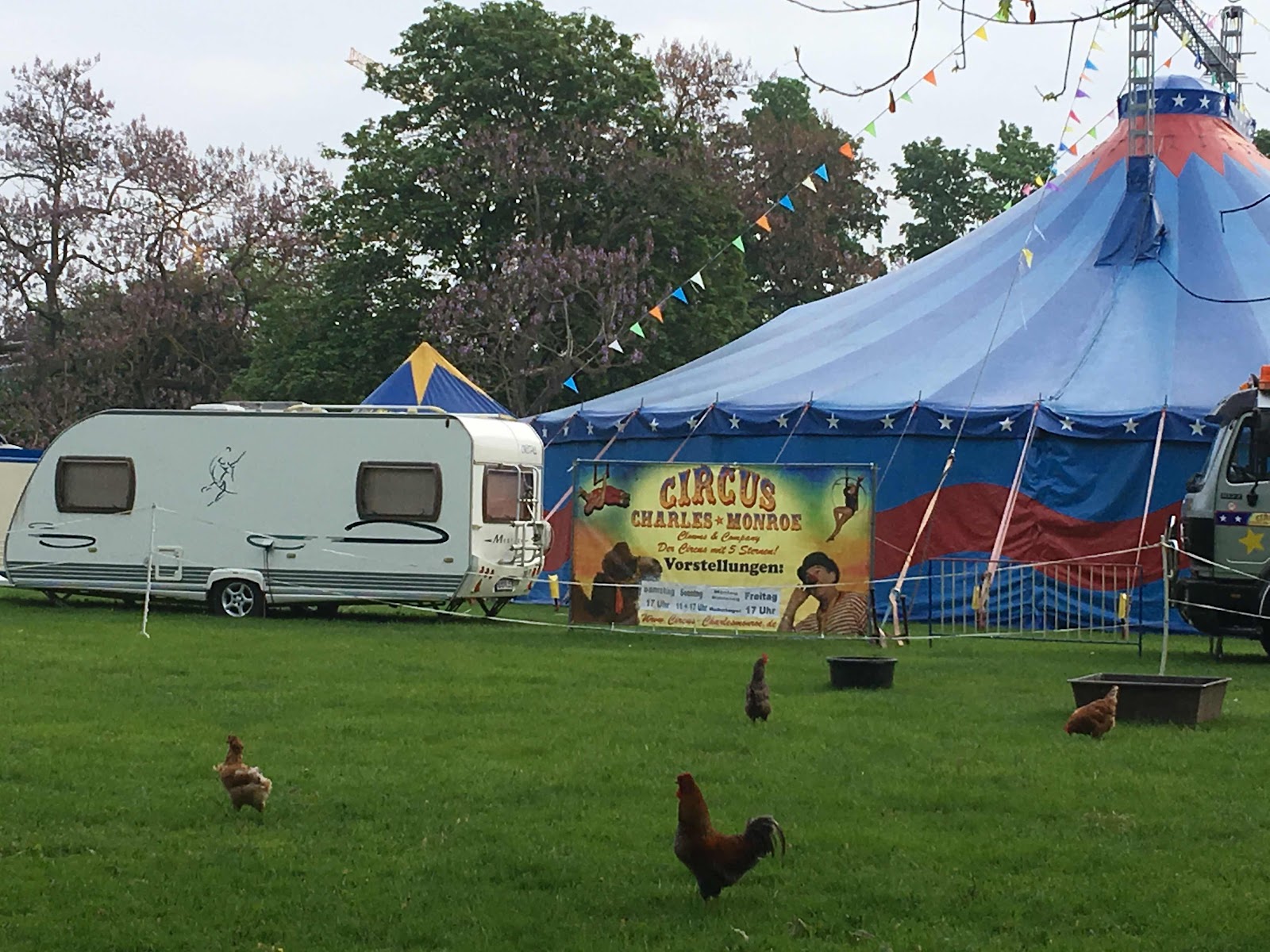
Another sight I missed on my first walk in the dark through the Cologne “forest” was this little circus tent with a rooster and his chickens wondering out in front of it.
I loved walking by and hearing the rooster hail the morning with his “cock-a-doodle-doo” as he strutted around keeping an eye on his hens. I do not think I will ever see a rooster again without thinking of my friend Robert Heidbreder. I knew Bob in college and have been thinking of him as our 50th reunion approaches (which I decided after much vacillation to attend - immediately after the Europe trip, without even going to home in between). I contacted Bob to see if he was going to the reunion and he sent me two of his recent books. Bob, who moved to Canada because he was unwilling to participate in the Vietnam war, which he and I like so many of our generation believed to be an unjust war. He made a wonderful life for himself in Vancouver, becoming a teacher and a writer of poetry for young children. One of the books he sent me, Rooster Summer, told the story through the poems of two children spending a summer with their grandparents on a farm. The poems celebrated the the connections with the land and plants growing, the farm animals, including a rooster and mule who became their special friends, the daily work of tending plants and collecting eggs, and the wild hilarious play that went along with the work. When the children went home, sad to leave behind their idyllic summer, the grandfather gave them a kitten whom they named Summer. Back st school, they wrote stories about their happy memories. The book ends with a little note that says that the farm in these stories no longer exists - where it once was there are buildings and parking lots now. But, the note says, we still have the stories. It compares stories to seeds that grow. Robert’s book reminded me of Wendell Berry’s fiction in its deep appreciation for the way of life that is made possible by farm life and the connection to one another and other living things and the seasons of growth that farm life makes possible. But unlike Berry, there was a focus on play as much as on work, and on story and hope - the way stories like children and like the seeds that the farmer plants are living and will grow into something new and astonishing.
I really feel proud to have known Bob and also amazed that he had all those stories and all that capacity for play inside him, so much inner world, that I never caught a glimpse of though I loved him as a cherished friend. I feel curious when I go back to my reunion what I will discover in the place, in all the people I never came to know, as well as the very few who became friends with, that I overlooked at the time.
Enough for now. Thank you for walking with me. See you further down the trail.

Comments
Post a Comment