May 26 -28. London Heathrow to Denver Colorado to Littleton.
Sunday, May 26. Bus to Heathrow, flight to Denver, car ride to Littleton. Monday May 27 in Littleton. Tuesday May 28. Leaving for Iowa and Grinnell College reunion in the afternoon.
I landed in Denver, went through customs with Chris and went our separate ways, she to her flight to Seattle, I to meet my friend Doris.
And I want to show at least one photo of the beautiful walks through green spaces that I took, both a long walk with Doris and several walks alone, feeling grateful as always for the green world and how it helps me to relax and to touch the earth with my feet and my soul, and to breathe. Photo 3 has a heron you probably can’t see (it’s standing on a rock you might think of as the third rock from the shore in front of the little bit of falling water) that Robert spotted from his bike and waited to point out to Doris and me (on foot). We couldn’t see it either for quite a long time. Doris told a story of a heron landing near them on one of their first dates and how the presence of that beautiful shy bird felt like both omen and blessing.
When I was walking alone I was enchanted by a heron sculpture - that you probably also can’t see - in photo 3.

Look at the tree (across the lake) with a long shadow stretching to your right toward the barn with a yellow door. Okay now look at that tree’s reflection in the lake. On the left edge of that reflection the heron reflection stands - very near the shore.
Dear Trail Friends,
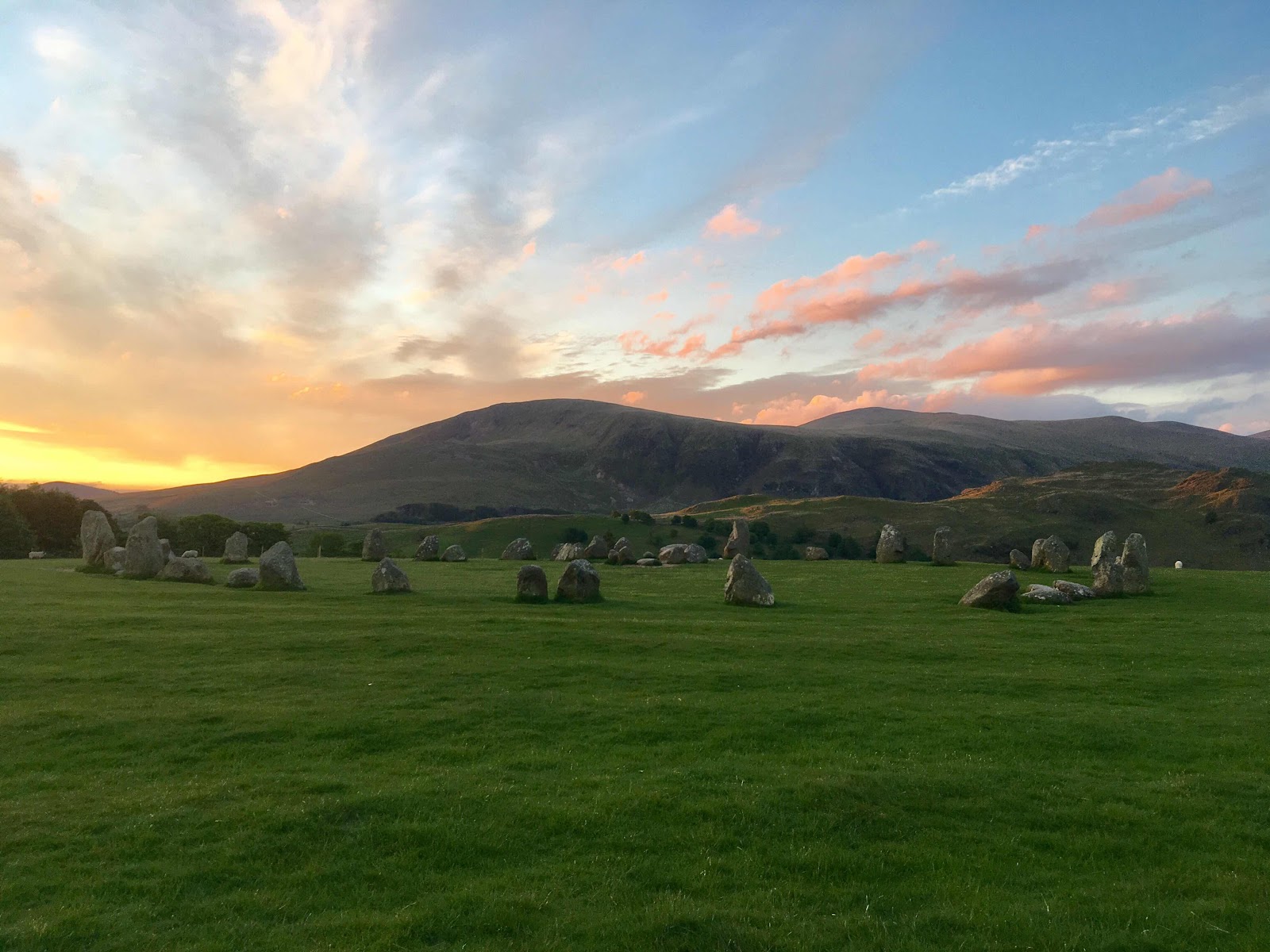
London is 7 hours ahead of Denver, and my Sunday is stretching itself out (as we fly in the same direction as the sun, postponing sunset) into a 31-hour day. Okay. I know the sun doesn’t actually travel from East to West - it’s really our little planet’s rotations that make it seem so. Trying to visualize this comes up against my difficulty with directions and spatial thinking, and I associate my confusion with time and rotations to the spiral staircase at The Wolseley, and the sense of time as a little vertiginous and dizzying, and also to the sunrise illuminating the stone circle at Castlerigg. I hope you find my associations as fascinating as I do. Maybe it gives you a chance to empathize with analysts (with yourself, if you dare one, and certainly with my imaginary Professor Freud who never even had the option of refusing me as a patient, given that he depended on me and my imagination for his existence. If he fired me as a patient he cast himself back into oblivion.)
The latter associates to the reading I just completed for the “Alumni College” lectures that precede my 50th Grinnell College reunion (This particular article was about teaching the history of slavery in America to elementary, middle and high school students). The reading touches a sore spot in me. I discovered for the first time (after my brother Scott’s visit to the Malcolm castle in Scotland) that my distant Malcolm ancestors belonged to a clan that profited enormously from the slave trade. I thought of the horrors of the Middle Passage and tried to imagine how human beings - my ancestors - participated in such brutality against other human beings in order to enrich themselves. I had already known (I may have written about it in this blog) that my maternal ancestors were enslavers in the south. (I am learning that the terms of choice these days are “enslaver” and “enslaved person,” - because the noun “slave” tends to reduce the enslaved person to an object of commerce, just as the institution of slavery does, and the person using that language unconsciously colludes with it. Now to be honest part of me stiffens and resists being told what language I must use to be “politically correct.” But another part of me notices that the different language creates different emotion and meaning. Life is so complex, and moral navigation so challenging.)
Two quotes were used to begin another article I read for the Alumni College. (This article was about a series of etchings by a South African artist Diane Victor titled “Disasters of Peace” - referencing in its title Goya’s “Disasters of War”). The quotes have deep resonance for me. Here they are:
From Jean Paul Sartre - All violence presents itself as the recuperation of a right and, reciprocally, every right contains within it the embryo of violence.
From Giorgio Agamben - How can art, this most innocent of occupations, pit man against Terror?
The first quote helps me to imagine how my ancestors’ desire for money and power might have ecliosed what I hope is an innate human aversion to witnessing and participating in brutality toward other human beings (including women and children). Even as I write that I think of peoples’ fascination with violence and brutality, the crowds who turned out to witness public torture and execution, the fact that the news that sells most and is most popular is news about horrors we humans do to each other. I find it terrifying to think and write about these things. How do I learn to accept what cannot be changed in human nature (my own, my contemporaries’, my ancestors’) and still have some sense of moral direction and responsibility and choice. What at this late stage of life is my responsibility to our suffering world? Is there anything with my limited abilities that I can do that makes a difference, that eases suffering, limits brutality, and adds to love and beauty?
Fifty years ago as an undergraduate at Grinnell College in the late 1960s, I had a horror of the brutality I had witnessed in my own home (my stepfather’s verbal violence and physical violence against my step-siblings) and world (I knew about overt racial violence and witnessed the covert violence of exclusion - black people at that time were excluded from restaurants, amusement parks, public toilets in Oklahoma). My stepfather refused to let me participate in a civil rights protest and in my mind his brutality and the larger brutality were all of a single fabric.
I suppose I wanted most of all to eradicate my stepfathers brutality. To make it never have existed. Instead I joined the New Left and imagined we could create a world based on peace and justice, a world liberated from the inhuman treatment of human beings by one another. It was a beautiful dream. But in pursuit of it I was in my way as oblivious to my impact others as my ancestors who enslaved and profited by the enslavement of others.
It took me years to discover my own brutality and to turn away from politics to psychology. My hopes for contributing to the world became very modest.
****
It is now May 31 and I am sitting in my dorm room at Grinnell College, overwhelmed by too much stimulation, too many people, too many encounters, too many unexpected emotions (in response to so many lost memories but also found memories, so much radically changed in the campus but also places that seem unchanged), by the collision between the outer world that is like and unlike the past and the ghosts of that past that are coming back to life in my inner world.
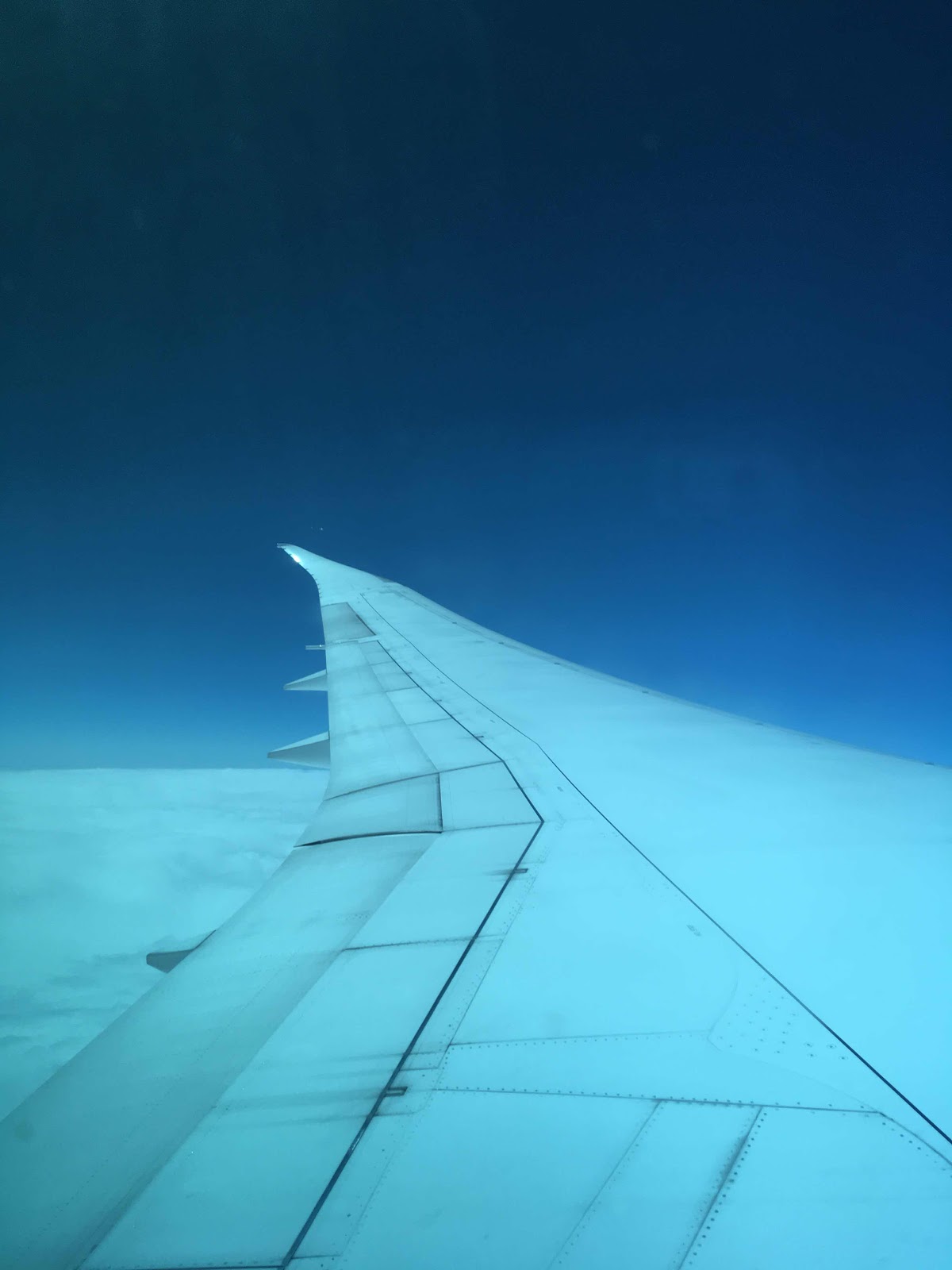
I want to end this post so I can begin another. To do that I will share photo 1 to represent my journey home - the view of the airplane wing from my seat. I felt prematurely severed from Chris because I offered my seat so a mother and her young daughter could have seats together. Being on the same plane but separate felt strange. Looking out the window, similarly severed from earth/ground, contemplating the mystery of wings that allow a heavy plane to sail through the sky, and experiencing that strange sense of being between places and lives and selves.
I landed in Denver, went through customs with Chris and went our separate ways, she to her flight to Seattle, I to meet my friend Doris.
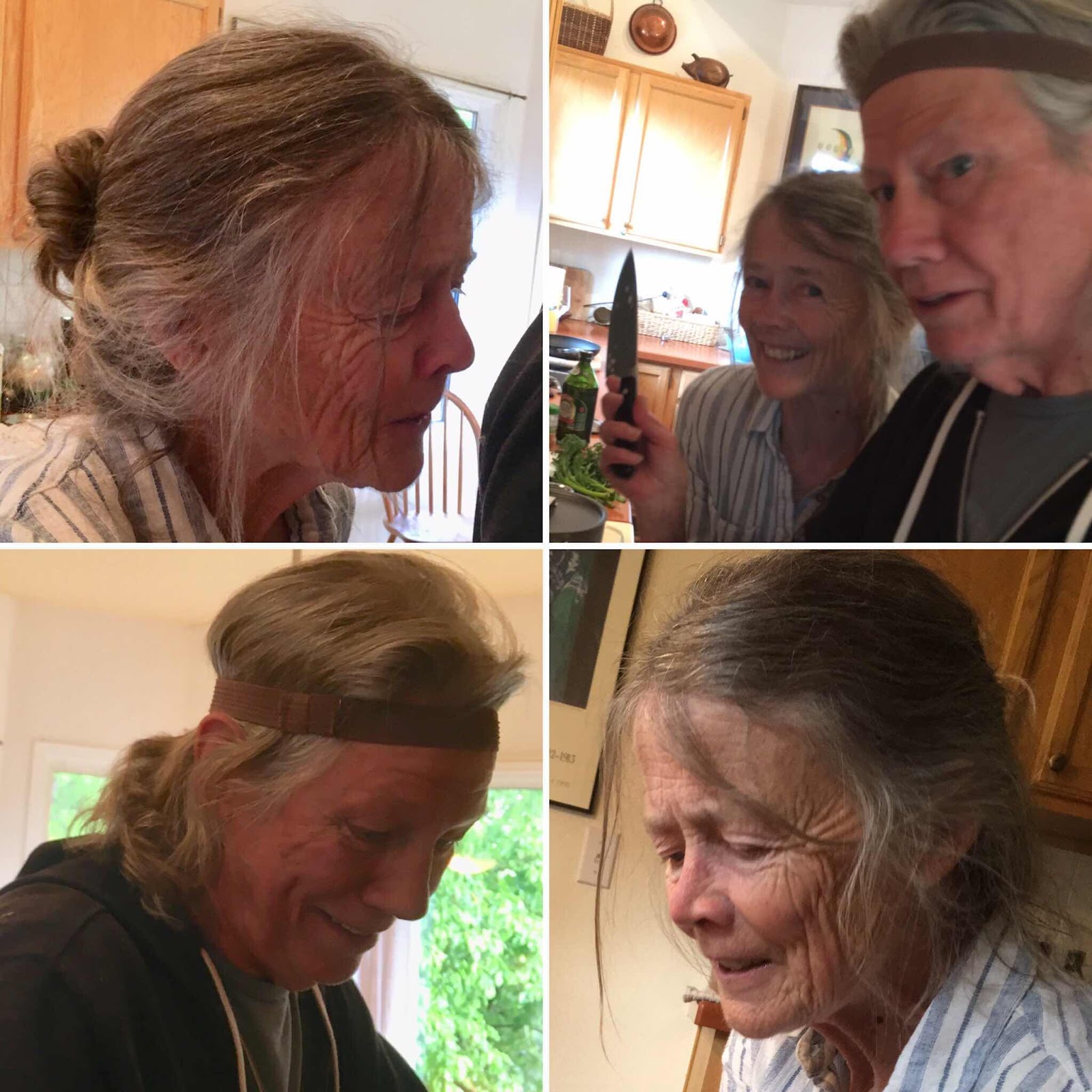
Photo 2 is a collage of Robert and Doris preparing dinner. I will not be able to find words to summarize my time with these two beautiful people. I want to share their stories but they are too private and personal. I want to show you their faces as they spoke and listened. I want to convey Robert’s art of telling a little story, then inviting a story in return, a call and response that reminds me of dance or of sports. I want to talk about Robert talking about two kinds of football players, those who want to run away from others, and those who want to crash against them, talking in a way that brought football to life for me as a beautiful metaphor for the human condition and the conflicts within and between us. I want to talk about their live for their families, and how they cultivate connection with gatherings and stories, gardeners of loving connection. How we sat with yearbooks open and talked about Bishop McGuinness High School and people and families we remembered. How they have kept those connections alive too.
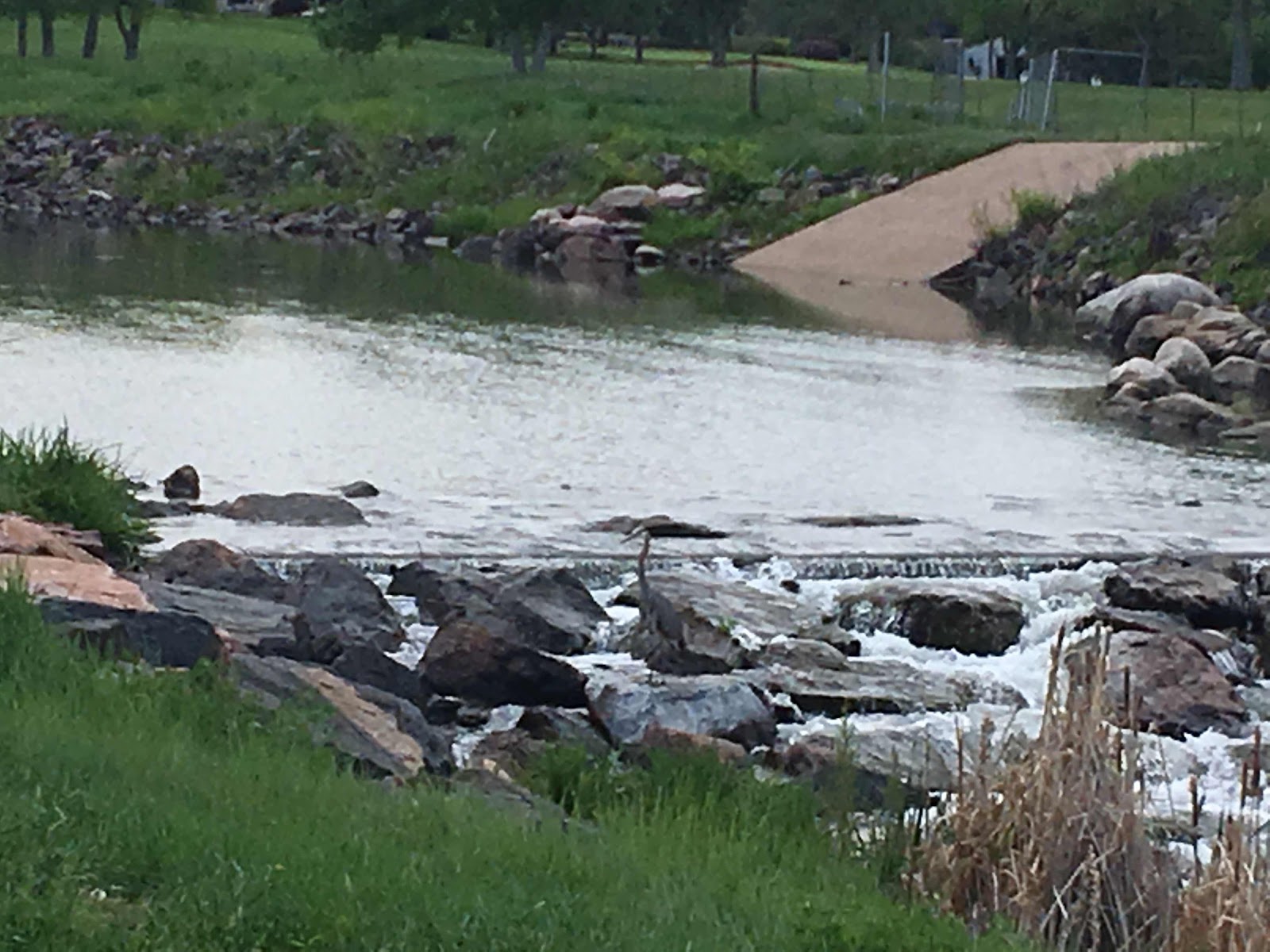
And I want to show at least one photo of the beautiful walks through green spaces that I took, both a long walk with Doris and several walks alone, feeling grateful as always for the green world and how it helps me to relax and to touch the earth with my feet and my soul, and to breathe. Photo 3 has a heron you probably can’t see (it’s standing on a rock you might think of as the third rock from the shore in front of the little bit of falling water) that Robert spotted from his bike and waited to point out to Doris and me (on foot). We couldn’t see it either for quite a long time. Doris told a story of a heron landing near them on one of their first dates and how the presence of that beautiful shy bird felt like both omen and blessing.
When I was walking alone I was enchanted by a heron sculpture - that you probably also can’t see - in photo 3.
Look at the tree (across the lake) with a long shadow stretching to your right toward the barn with a yellow door. Okay now look at that tree’s reflection in the lake. On the left edge of that reflection the heron reflection stands - very near the shore.
Why it’s important to me that you see it I can’t begin to explain. Except to say thank you. I feel the deepest peace I have felt in days just sitting here pointing out herons to you. The feeling that I am deluged with experience, swept away in a flood, that the world around me and especially the world within me will never stand still enough again for me to pretend that separate things exist and have constancy and that I can name them. Language so distorts reality and so comforts and gives benediction. And it is the shared nature of language - the “you” and “me” of it - that creates this mysterious power. Here we are. Here is a heron.
Thank you. Now I will try to write about being at Grinnell.

Comments
Post a Comment