May 5. Prague and Terezin
Sunday May 5. Prague and Terezin.


I was also struck by a description of those rare individuals who survived as being immensely grateful to be alive and determined to find joy in every day of their lives. I associated this with one of the rare light-hearted images in the museum - a sculpture of a girl dancing with a butterfly on her shoulder (photo 7), which somehow connected for me with a butterfly drawing by one of the children at Teresin who did not survive (photo 8). 

My drawing today grew out of contemplation of that dancing with a butterfly statue and the hope it represented to me: the hope of providing shelter and guidance and moments of joy for the young, both as a way of nurturing hope that they would live and as a way of giving value to their lives, however short. This of course makes me think of my niece Josie and her too early death. I haven’t found a hair tie “message” from Josie since we got to Prague but Chris found one as we walked through the Jewish cemetery in Terezin, Photo 9 is my drawing.

Chris’s lecture tonight was related to our next trip Tuesday (day after tomorrow) to Pribor, Freud’s birthplace. She spoke of how important the death of Freud’s father was in his life, how it led to the discovery of his deep disappointment and anger at his father for not being a better provider and so making it necessary for the family to leave the small rural village (where the very young Freud had lived close to the beauty of the natural world) and move to Vienna. Up until his father’s death he had thought he was unambivalent in his love and respect for his father. The discovery of his intense ambivalence led in turn into deep self analysis (Freud, Chris said, saw himself as his most difficult patient) and his awakening to hos personal connection with the tragedy of Oedipus in the Sophocles play. He recognizes his guiltin relation to his father’s death, and his longing to return not, only to the imagined lost paradise of his childhood rural home, but to the arms of the imagined mother of his infancy, the imagined lost home of her unconditional love and undivided attention.

Thank you. I almost feel as if you are holding my hand, consoling me with your witnessing presence. See you on the trail.
Dear Trail Friends
Today we made a day trip (about an hour each way by bus) to Terezin. I am not sure where to begin, so I think I will start by posting the drawings Judy and I did yesterday.
My drawing was inspired by a sculpture of three women (our local guide to Terezin told me the sculpture’s Czech name would translate roughly into English as Wild Women. I had thought they might be the three fates. ) photo 2 is the sculpture and photo 3 my drawing.
After I chose the color blue (because I didn’t have gray markers - I really wanted to do it on somber shades of gray) I began to think of the dancers and their dance as the movement of air or water. Fun to think of molecular motion as the whirling of wild women!
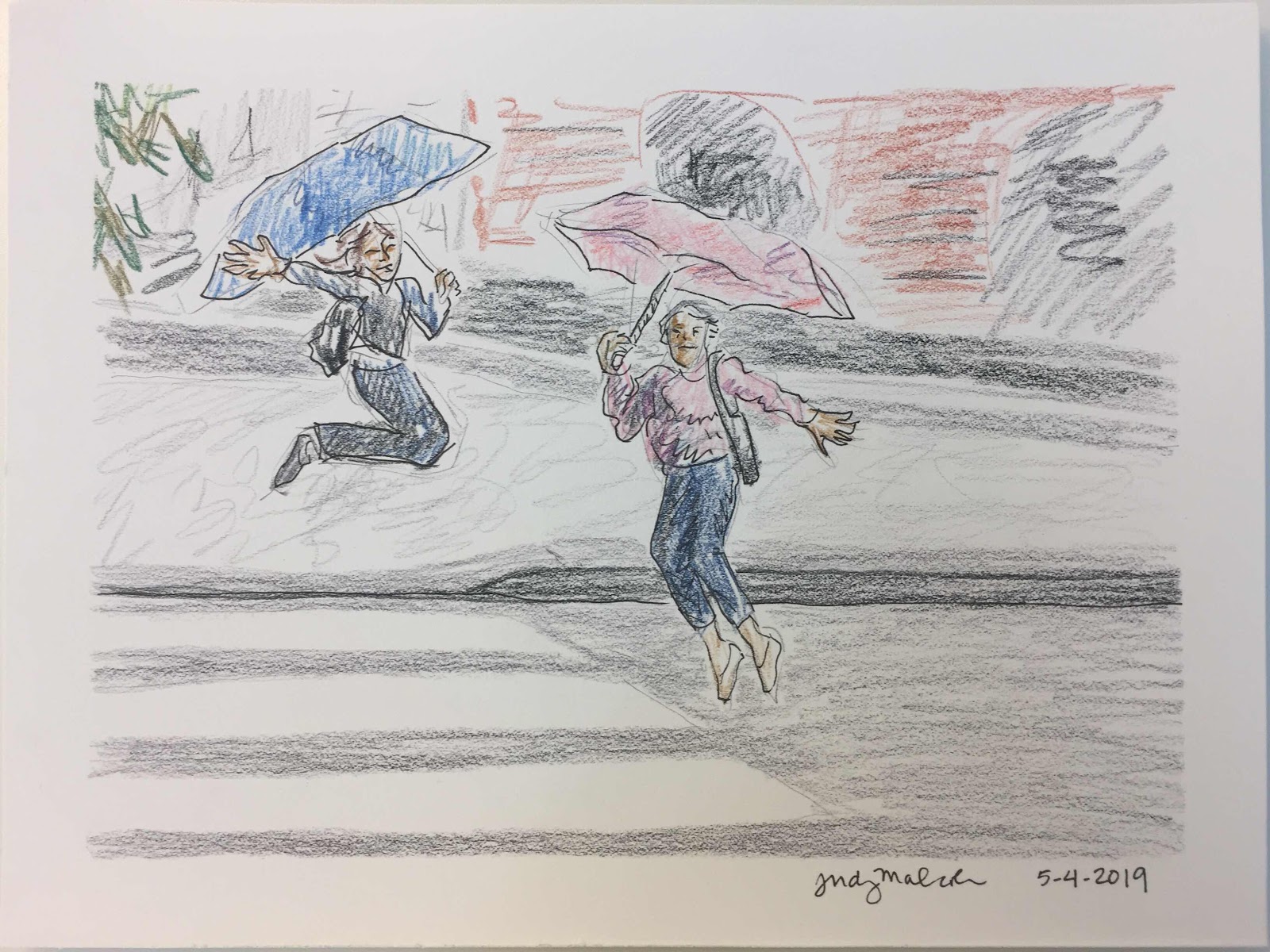
Judy’s drawing (photo 3) was inspired by a photo she took yesterday of two women with umbrellas jumping up into the air below the airborne (or seemingly so) sculptures we saw of people floating way overhead underneath their umbrellas.
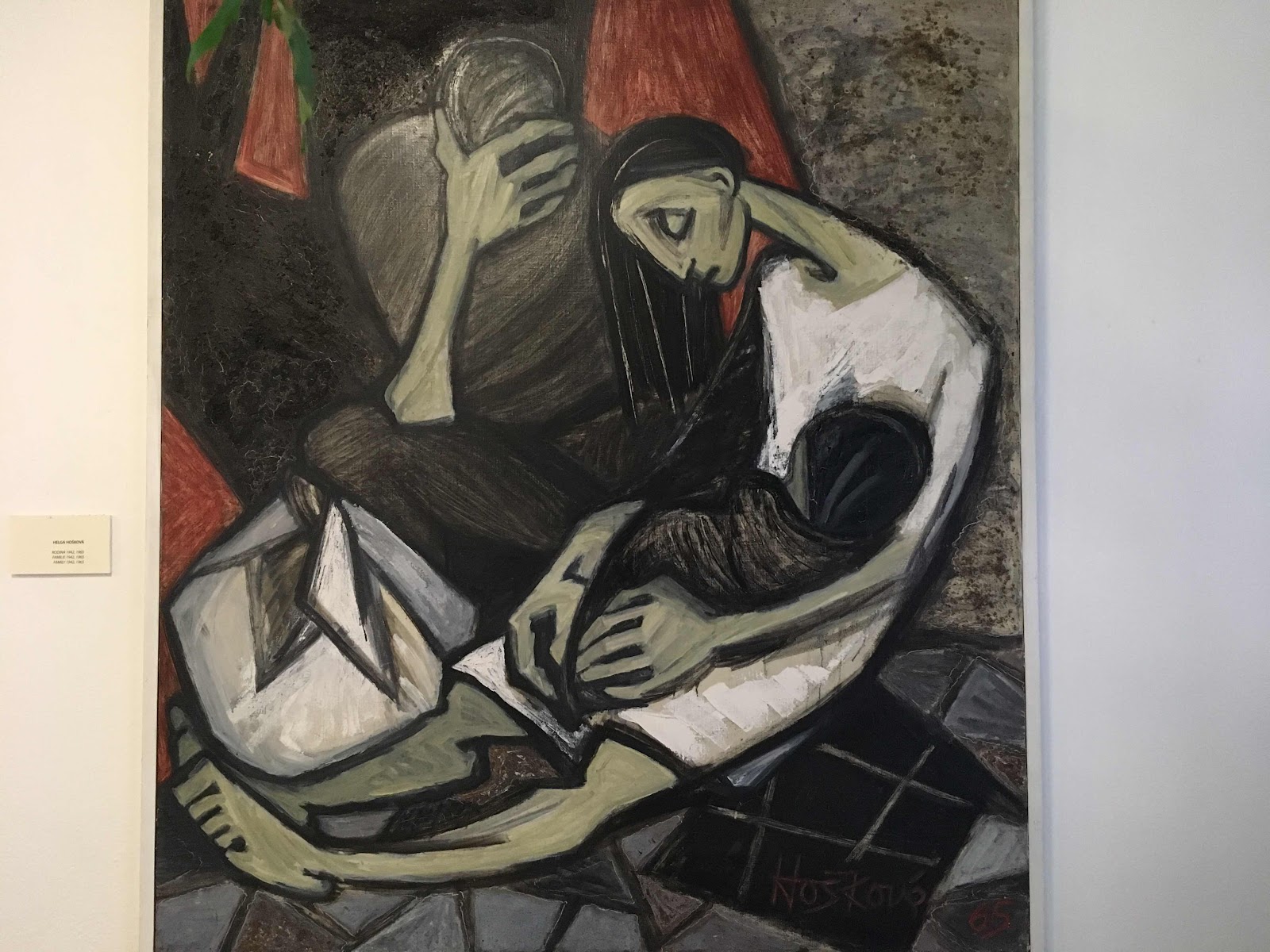
What can I say about our trip to Terezin? What has moved me the most, over and over again, is the way the adults in such an extreme situation tried to shelter and educate the children, and give them culture - art, writing, theater, music - to bring joy into their daily life and to create meaning and resilience in the face of great loss and hardship. In doing so, the adults in some ways “collaborated” with the Nazis and their deception (when they set up Terezin to look like a lovely city for the Jews in order to display it to the Red Cross, a city in which Jews could live a quality life, when the reality of course was that the people there were desperately crowded, underfed, vulnerable to all sorts of disease, forced into slave labor, and in any case they were in Terezin only temporarily before being transported further east to death camps such as Auschwitz or Treblinka. For me, being reminded of the numbers of people who died, seeing photographs and drawings of faces, seeing names with birthdates, transport dates and death dates, not to mention living in a contemporary world which seems to me to be in danger of committing similar crimes on a similar or even greatervscale (on the cusp, as my tour mate John put it), I felt myself to be in a state of emotional shock that I think I saw reflected in the faces of my tour mates, and in the art work in the museum, for example the painting in photo 4. The hand over the face resonates deeply with what I felt.
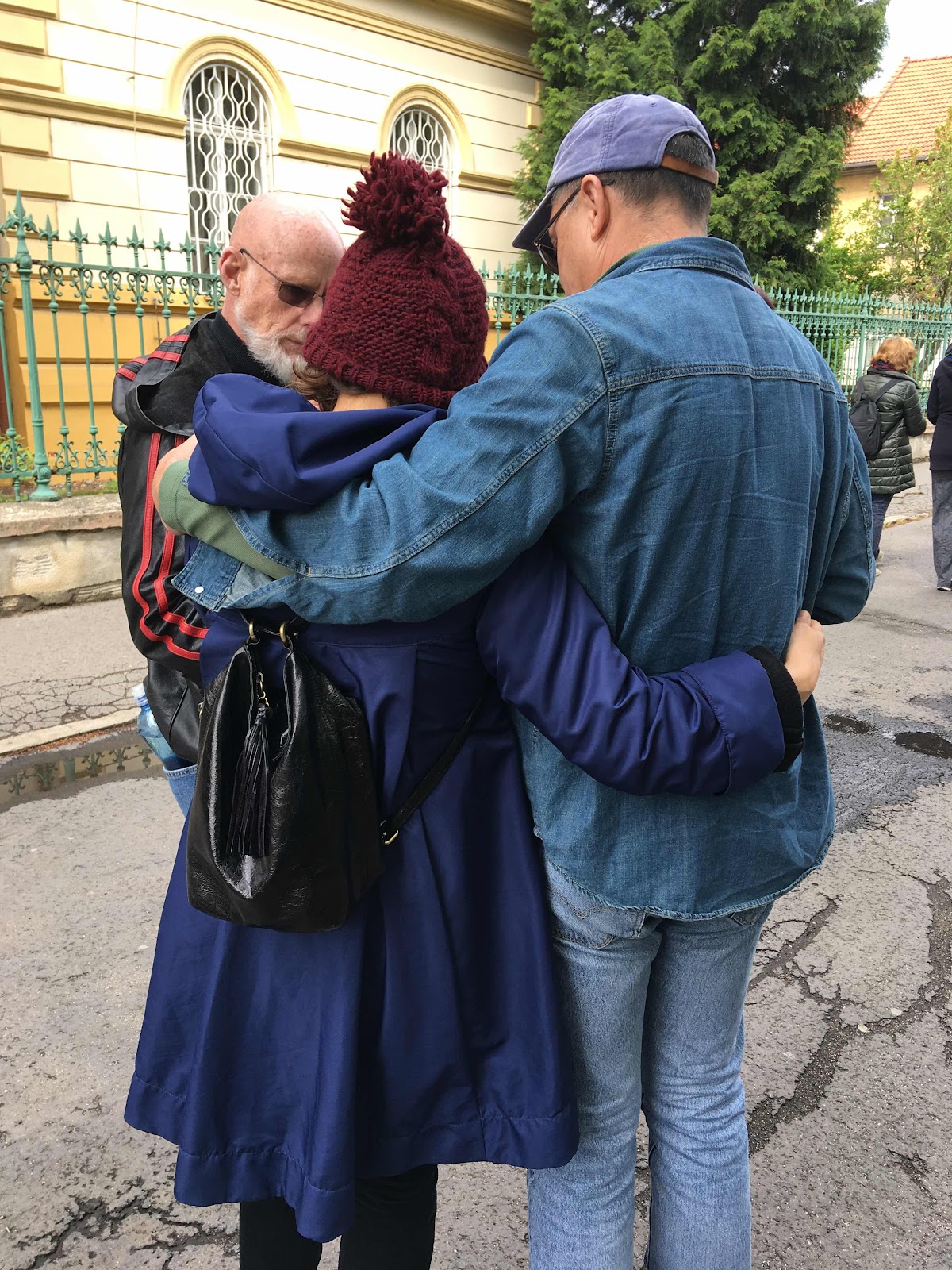
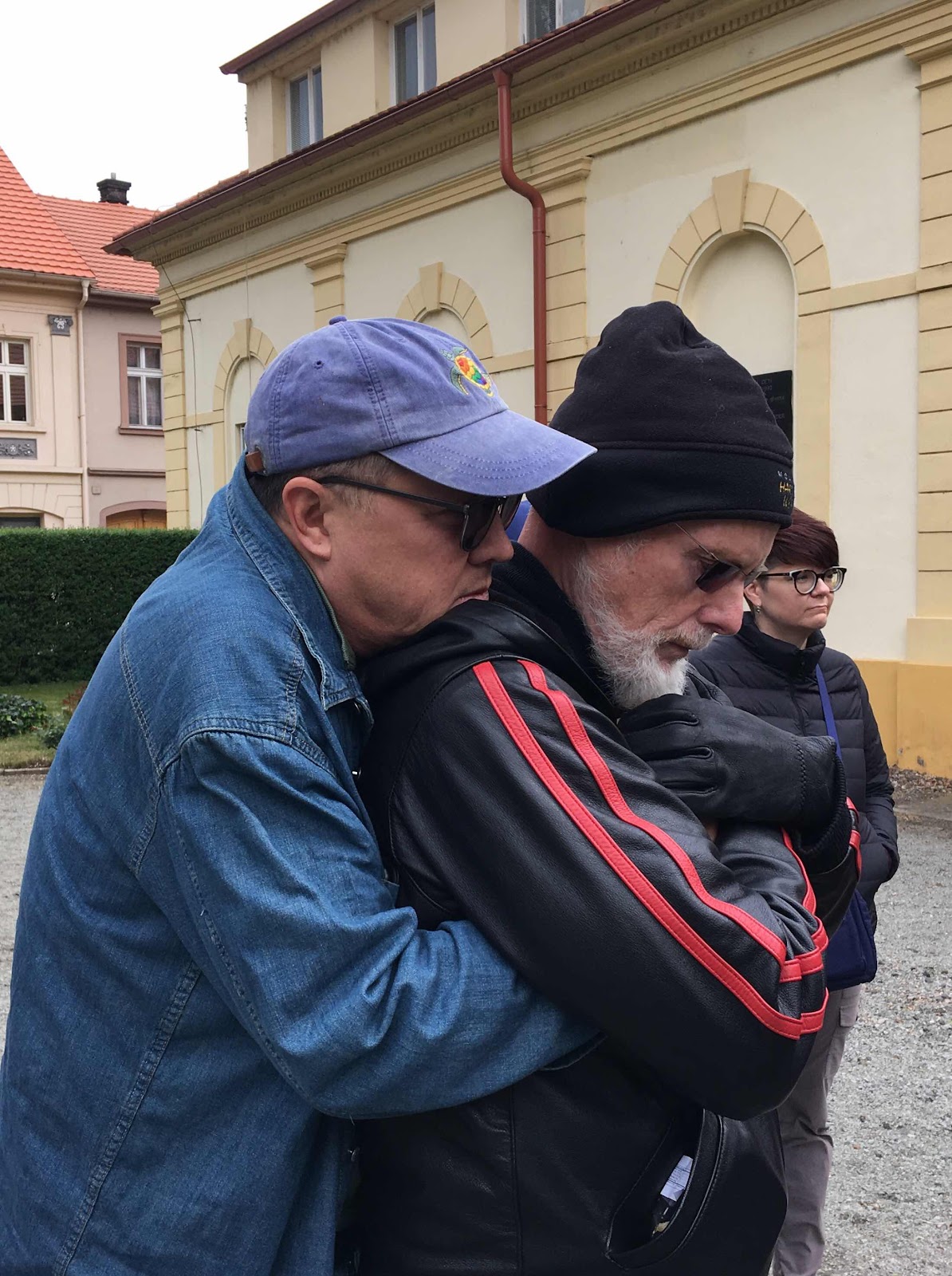
I found solace in seeing members of the tour group console each other, as in photos 5 and 6.
I was also struck by a description of those rare individuals who survived as being immensely grateful to be alive and determined to find joy in every day of their lives. I associated this with one of the rare light-hearted images in the museum - a sculpture of a girl dancing with a butterfly on her shoulder (photo 7), which somehow connected for me with a butterfly drawing by one of the children at Teresin who did not survive (photo 8).
My drawing today grew out of contemplation of that dancing with a butterfly statue and the hope it represented to me: the hope of providing shelter and guidance and moments of joy for the young, both as a way of nurturing hope that they would live and as a way of giving value to their lives, however short. This of course makes me think of my niece Josie and her too early death. I haven’t found a hair tie “message” from Josie since we got to Prague but Chris found one as we walked through the Jewish cemetery in Terezin, Photo 9 is my drawing.
Chris’s lecture tonight was related to our next trip Tuesday (day after tomorrow) to Pribor, Freud’s birthplace. She spoke of how important the death of Freud’s father was in his life, how it led to the discovery of his deep disappointment and anger at his father for not being a better provider and so making it necessary for the family to leave the small rural village (where the very young Freud had lived close to the beauty of the natural world) and move to Vienna. Up until his father’s death he had thought he was unambivalent in his love and respect for his father. The discovery of his intense ambivalence led in turn into deep self analysis (Freud, Chris said, saw himself as his most difficult patient) and his awakening to hos personal connection with the tragedy of Oedipus in the Sophocles play. He recognizes his guiltin relation to his father’s death, and his longing to return not, only to the imagined lost paradise of his childhood rural home, but to the arms of the imagined mother of his infancy, the imagined lost home of her unconditional love and undivided attention.
I am as unable to summarize Chris’s lecture as I am to distill the experience of Terezin. I am really glad that Ben and Renee are filming the lectures to create a master class that will give more people access to them.
Meanwhile, I am struck that the images of the swan sitting on her nest (tending an egg that may never hatch) and the good King Wenceslas (riding with stalwart grace, and embodying hope and courage in spite of the fact that the horse he is riding is dead) relate for me to the Jewish adults of Terezin in their care for the children.
When I was a teenager I saw denial and minimalization as tantamount to collaboration. In my mother’s marriage to my alcoholic stepfather, I saw her attempts to pretend normalcy as betrayal. In my nightmares, I saw myself as a Jew and my stepfather as a Nazi. I think I cultivated habits of faultfinding and worry so that I would never become my feared “good German” who pretended that everything was alright, that the Holocaust wasn’t happening.
Now I begin to see how complex the holocaust was, how valuable it can be to keep hope alive even if it means colluding a little with the lies and deceptions of the “bad guys.” It allows me to see my mother’s way of coping in a new light - to see her as the swan on the egg that may never hatch, or the king on the horse that cannot stand upright and prance. She tried to create as much normalcy and daily joy as she could in a situation that was undoubtedly as difficult for her as it was for never
King Wenceslas by the way has a mythical role for the Czech people. If things get really bad, he and his soldiers will come riding out from the other world to save the people. Does the sculpture mean, as our guide suggested, that their hope is in vain because the horse is dead? So they must give up their hope and rely only on themselves. I wonder if it could it (also) mean that even though the horse is dead, one can still ride it with dignity and strength, and keep hope and normalcy alive, by living as if the dream could still come true.
I also wonder how might all this relate to exploring Freud’s world, starting with his birthplace, and to his discovery of his deep ambivalence not only for his father, but his awareness of the way in which all love also includes disappointment and anger and even hate, since in real life we are always thwarted in our longing to return to the imagined lost paradise of our mother’s perfect love.
I think it is time for me to go to bed. My mind seems to be running around in circles. Thank you for running around in circles along with me and may we meet on the trail again tomorrow.
But first - I wanted to take a photo of Chris dancing her lecture but of course motion is hard to capture in a still photo. So instead I include this photo of her lying on our hotel bed just before the lecture. Until this photo, I disliked the mural behind the bed. It had a feeling of chaos and collision that troubled me. But in this photo it feels more like art that can embrace chaos and difficulty. So here is Chris in the middle of a world filled with such complexities, relaxing before her lecture.
Thank you. I almost feel as if you are holding my hand, consoling me with your witnessing presence. See you on the trail.

A very moving post, with your own art work to capture something of the Ghetto. We have been there, right where you are. I still have a stone I picked up in the yard where the train cars would back up to deliver their prisoners. Thank you for capturing something of the human spirit to prevail even in such horrific surroundings. Sandy and I are right there with you all. Much love. Dennis
ReplyDelete