May 6. Freud’s Birthday. Prague.
Monday May 6. Freud’s 163rd birthday. Prague.
We had just walked through the grounds of the Museum of Camp (it being on our route to the Kafka museum), where a sculpture caught my eye (photo 2).
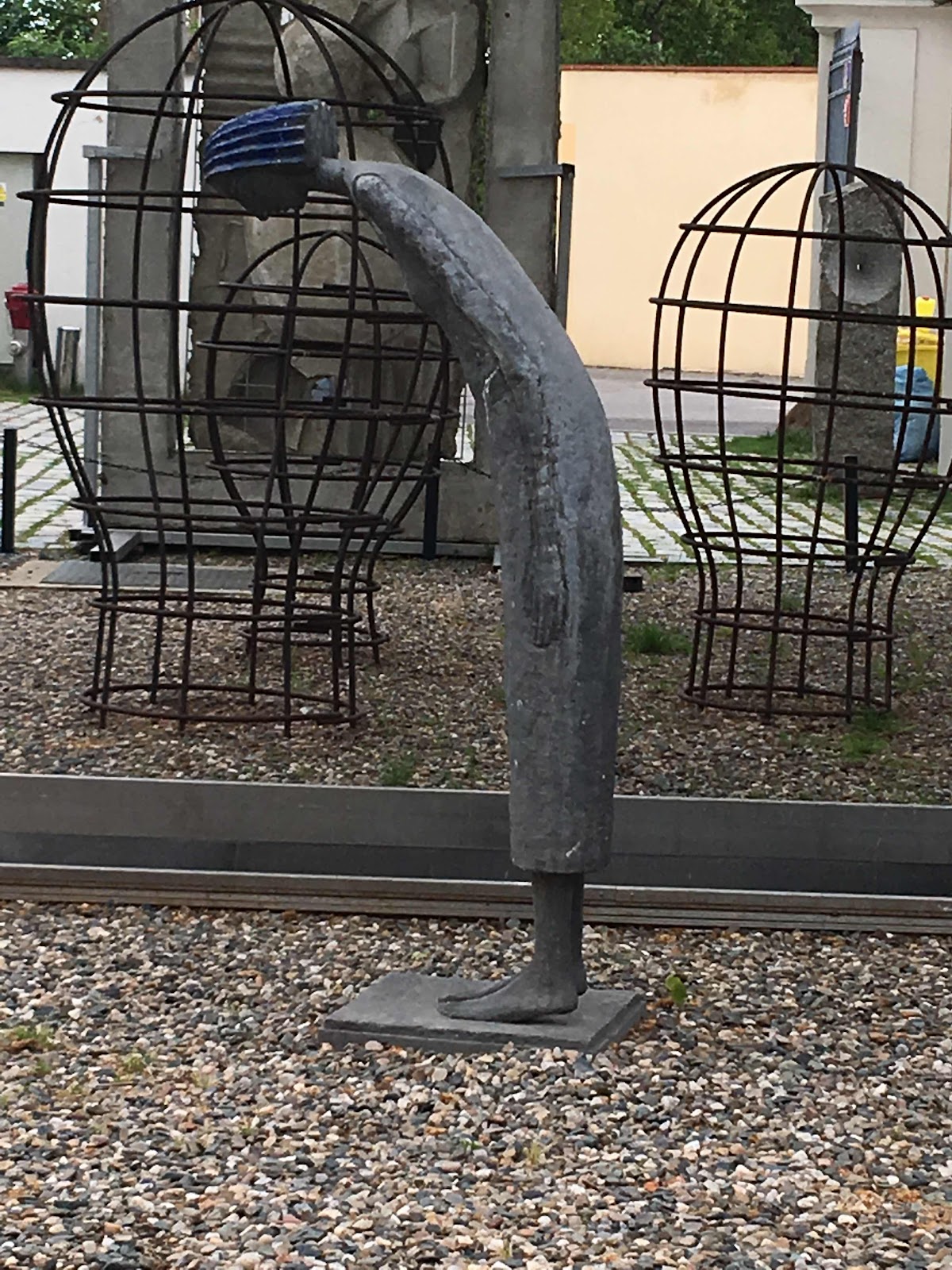
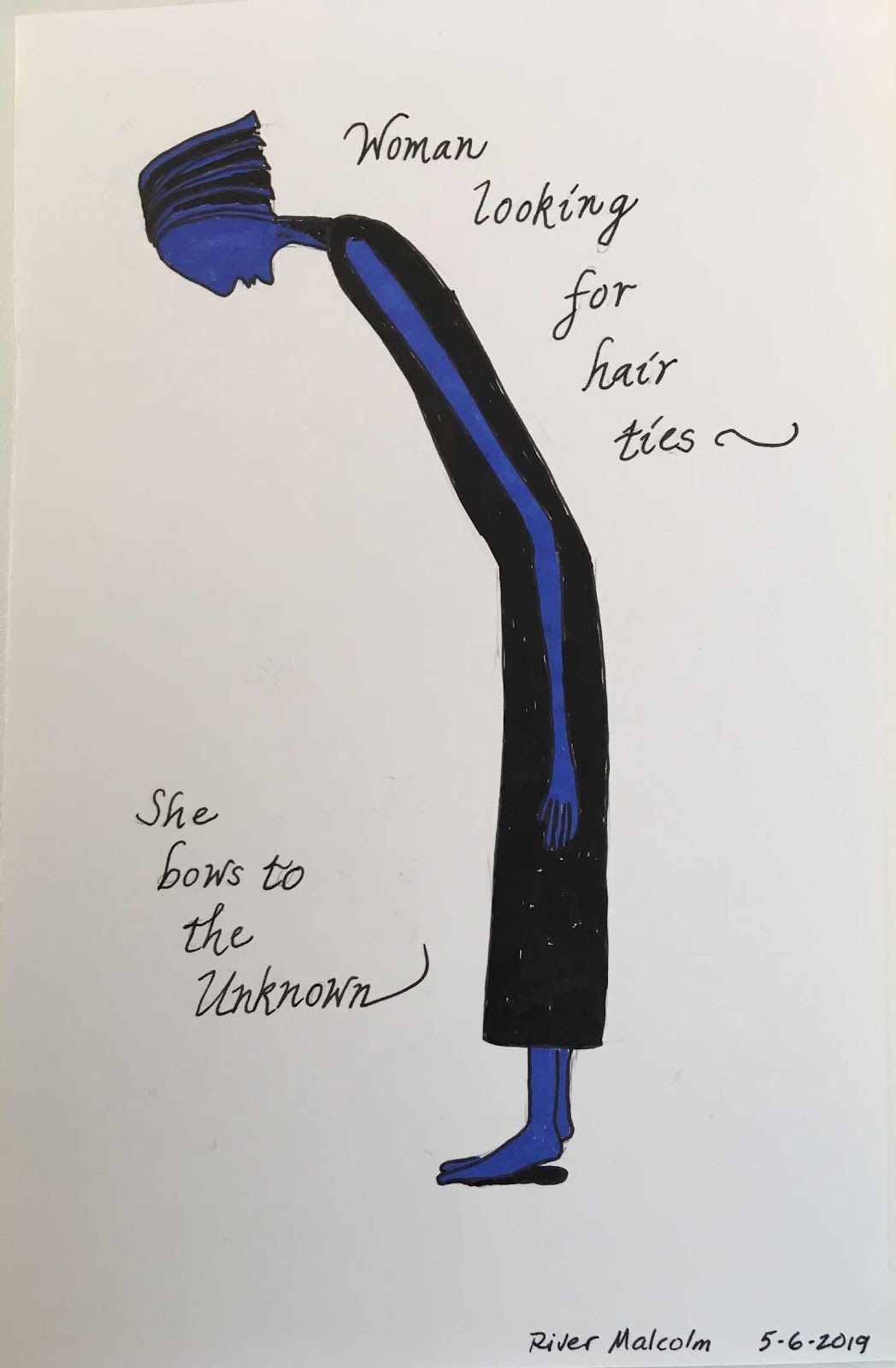
When I first saw this sculpture I joked that she was looking for hair ties. Later looking at the photo I found that the bend in her body had emotional power for me - it communicated reverence and acceptance, bowing to what is. The exact opposite of fault-finding and worry. So she ended up being the inspiration for my drawing. (Photo 3).
Judy’s drawing for today was inspired by Cerny’s babies ( installed at the Museum of Camp) - here it is in photo 4.

I also want to post her picture from Terezin. (Photo 5) I found it particularly moving because she combined the image of a young sister and brother who died in a death camp (from a photo at the museum) with an image of candles that came the crematorium where Jews were forced to burn the bodies of the dead, as there began to be so many people dying from disease and overcrowding that it was no longer possible to bury them. They were burned and their ashes were dumped into the river. The candles were part of a larger effort to create sacred space and honor the dead. I was struck by a quote that said something like “Memory is a bridge from the graves of the victims to the future.” In most cases the victims had no grave but it was important to survivors and descendants to build the bridge anyway. I know it was important to me to pick up pebbles and place them on the anonymous grave markers as my way of honoring of Freud’s sisters, three of whom probably passed through Terezin and then were transported to death camps to die, one of whom probably died there. As I face my own aging I can imagine both their reluctance to leave Vienna and the only life they had known, and the horror of facing forced transport and death without dignity or kindness. Yet it is the death of young children that haunts me and I love that Judy combined these candles of honoring and remembrance with the faces of children whose lives were cut off when they were so young. I am particularly moved by their eyes in the drawing and the quality of their gaze - they look directly at me the viewer, and their gaze. Their eyes seem to say “Here we are. “
The Kafka museum was very dark with the exhibits being small pools of light. The shapes of spaces were sometimes odd and I found myself feeling a quality of fear and fascination that was similar to what I felt as a reader many years ago now when I read Kafka. There was a very old film showing parts of Prague when Kafka was an adult and I was mesmerized. Cars shared the roads - the same roads I had walked on to get there - with horse drawn carts and carriages. Women washed clothes in the river. I felt as if I really were traveling back to an earlier time. Later that day when we walked up to the castle Peter pointed out that road had been in the film. I realized this would be the castle that inspired Kafka’s novel The Castle.

The museum began the exhibits with a letter Kafka wrote to his father (but never gave to him) when - if I understood correctly - the father had asked the son why he was so afraid of him. They exhibits suggested an Oedipal interpretation of the letter but I didn’t hear or see enough to find that persuasive.

The castle area and especially the church were architecturally breathtaking (photos 8 and 9) although frankly I was too socially exhausted to give them the open hearted attention they deserved.


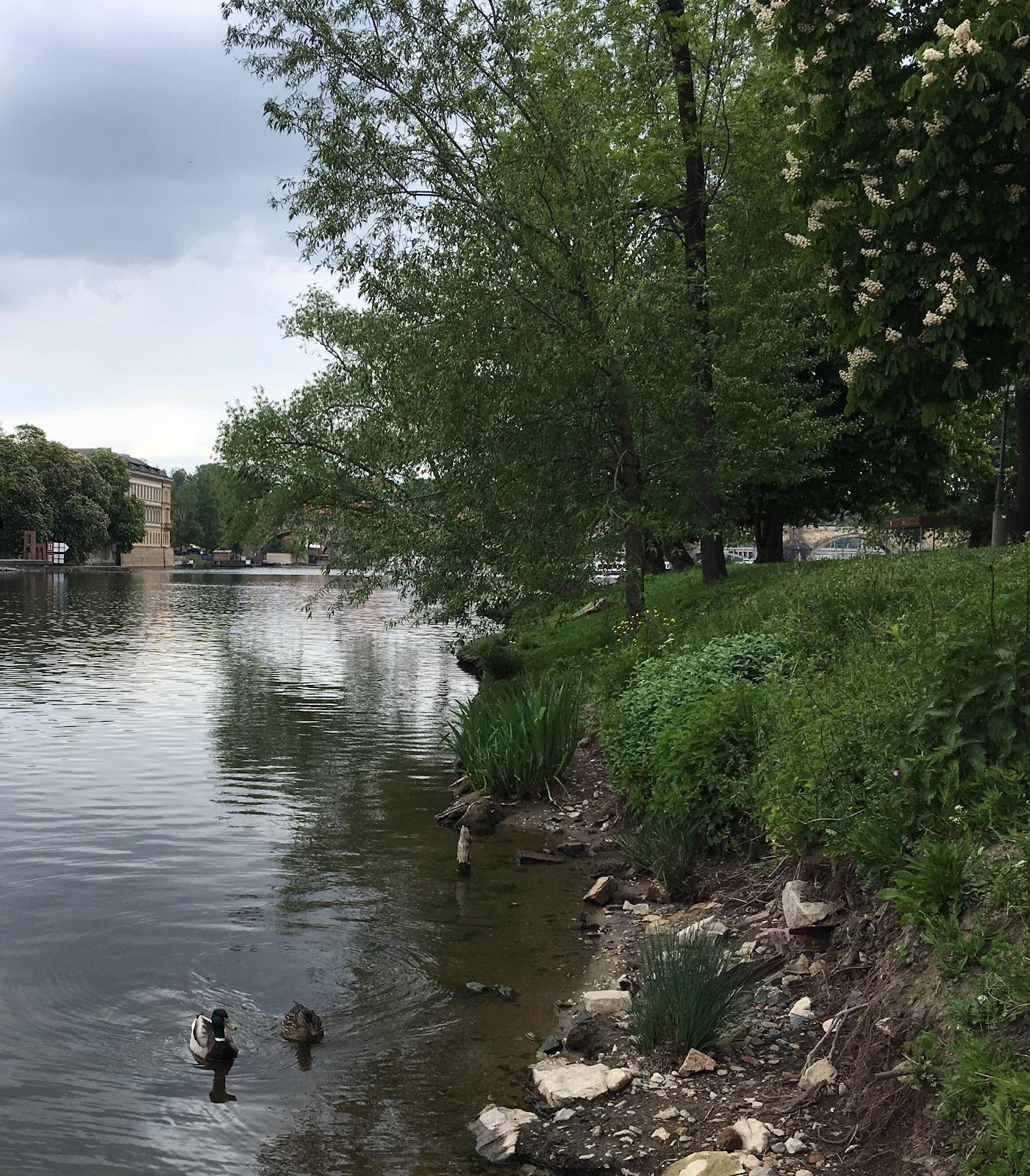
So after the castle I let the others head for lunch and went off for a solo exploration of a little island in the river where I could hang out near trees and water, no cars, few people. I hope Photo 10 conveys a little of the relief I felt. It was like a long sigh being able to walk at my own pace, steer my own way without explanation or apology or negotiation, and escape the sound and smell of the city for the green breath of the trees and their solid calm still presence and the slow ripples behind the ducks in the water.
I am thinking of Freud as a very little boy moving from the country to the city. When I was a little girl I could not understand why my father couldn’t be a farmer instead of a professor - so I could live in the country. Oh I also want to show you another photo of the Freud hanging out sculpture. This is by tour mate Ben - who is also filming Chris and seems to be quite a pro with a camera. Photo 11 is a close up of the sculpture.
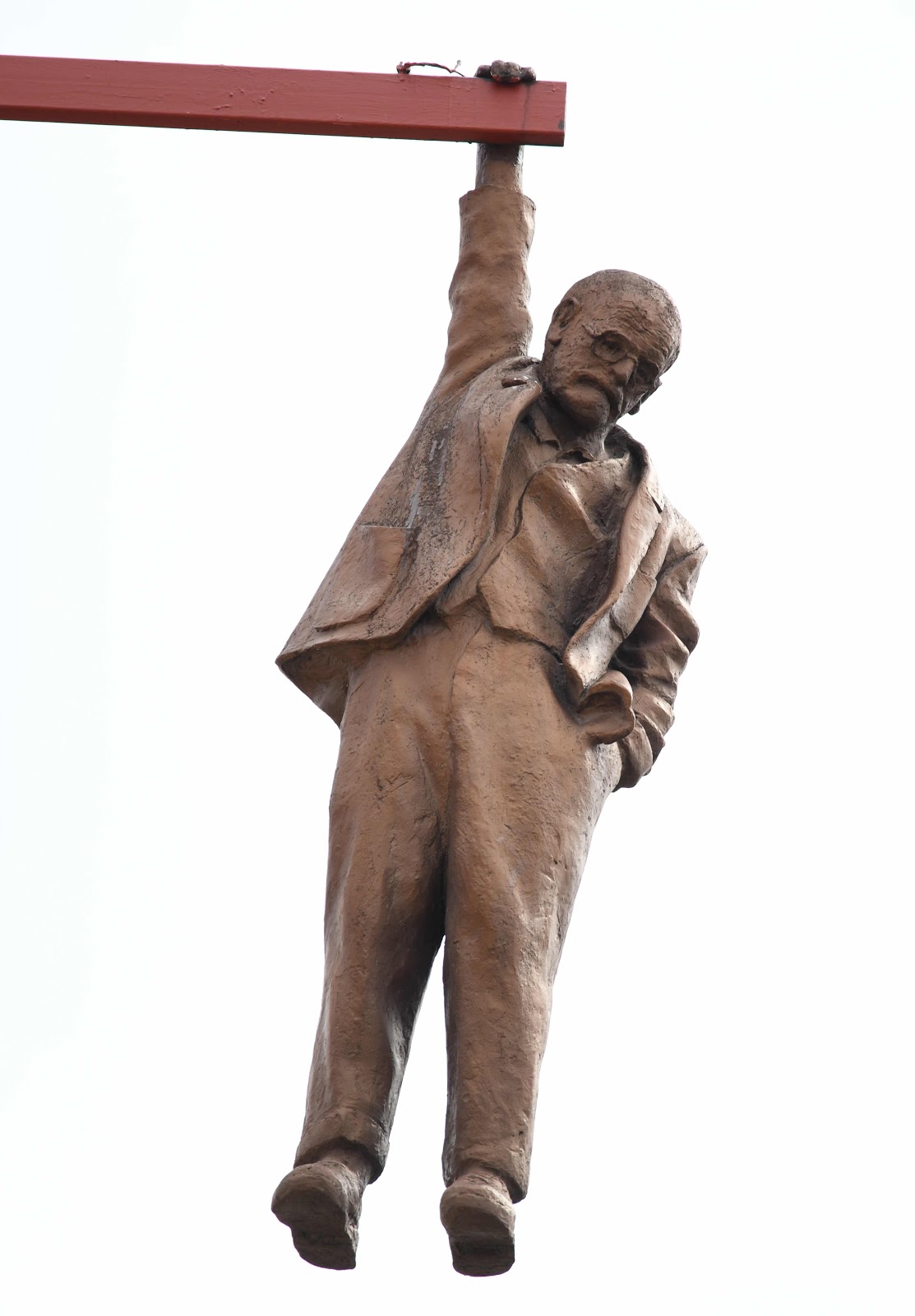
I am struck by the facial expression - the mouth reminds me of the jaw pain in his later life and the forehead suggests both concentration and suffering - and yet the left arm and shoulder look relaxed and there is a quality of resignation in the face, I think. What do you think?
Dear Trail Friends,
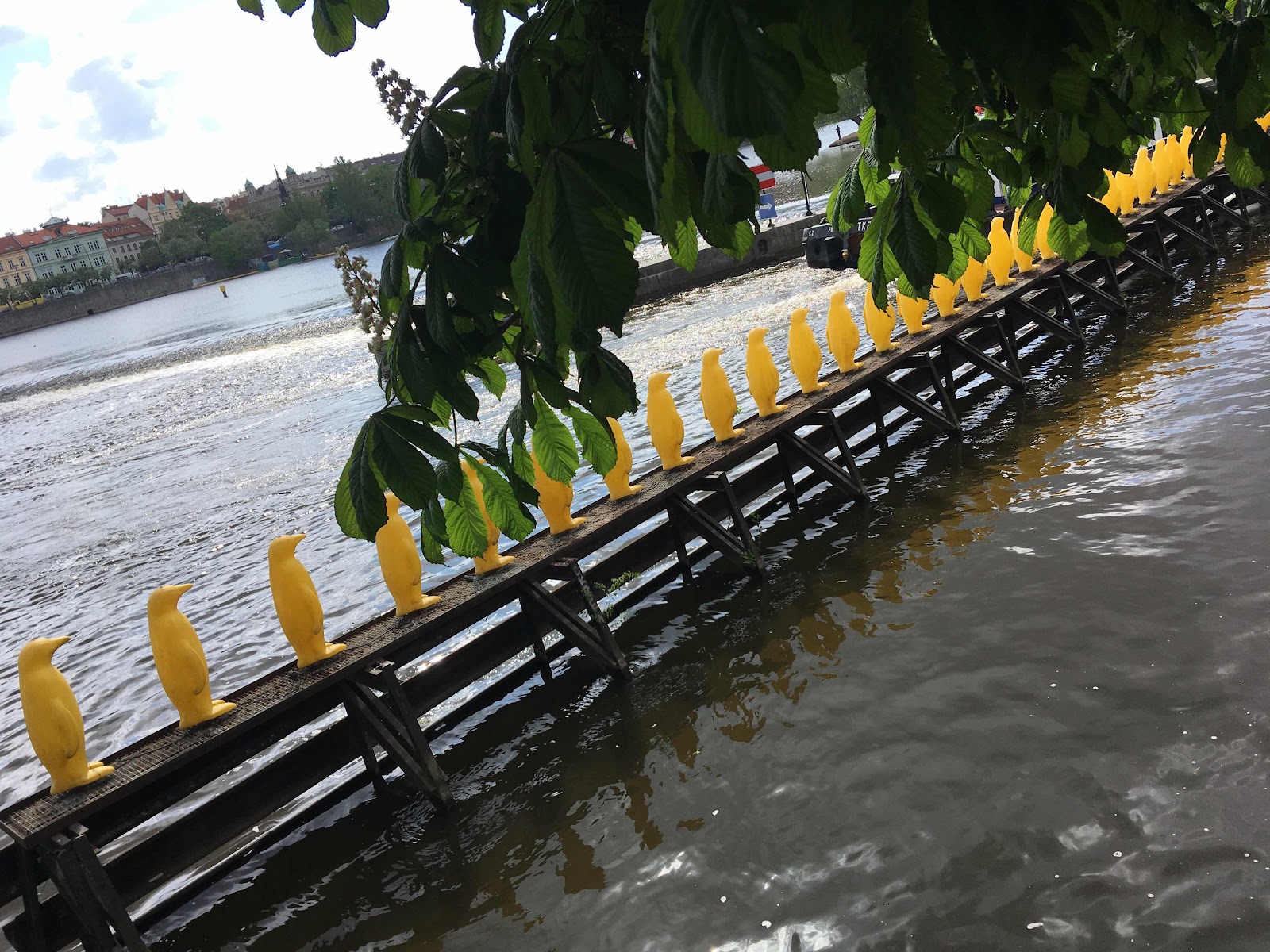
Today was a “free day” - no programmed group activities - so we went to the Kafka museum because other group members had found it moving. On the way I was struck by a parade of yellow penguins (photo 1) which I later noticed were lit up at night. Peter told me they are not just a whacky art installation: they help people on boats find the locks.
We had just walked through the grounds of the Museum of Camp (it being on our route to the Kafka museum), where a sculpture caught my eye (photo 2).
When I first saw this sculpture I joked that she was looking for hair ties. Later looking at the photo I found that the bend in her body had emotional power for me - it communicated reverence and acceptance, bowing to what is. The exact opposite of fault-finding and worry. So she ended up being the inspiration for my drawing. (Photo 3).
Judy’s drawing for today was inspired by Cerny’s babies ( installed at the Museum of Camp) - here it is in photo 4.
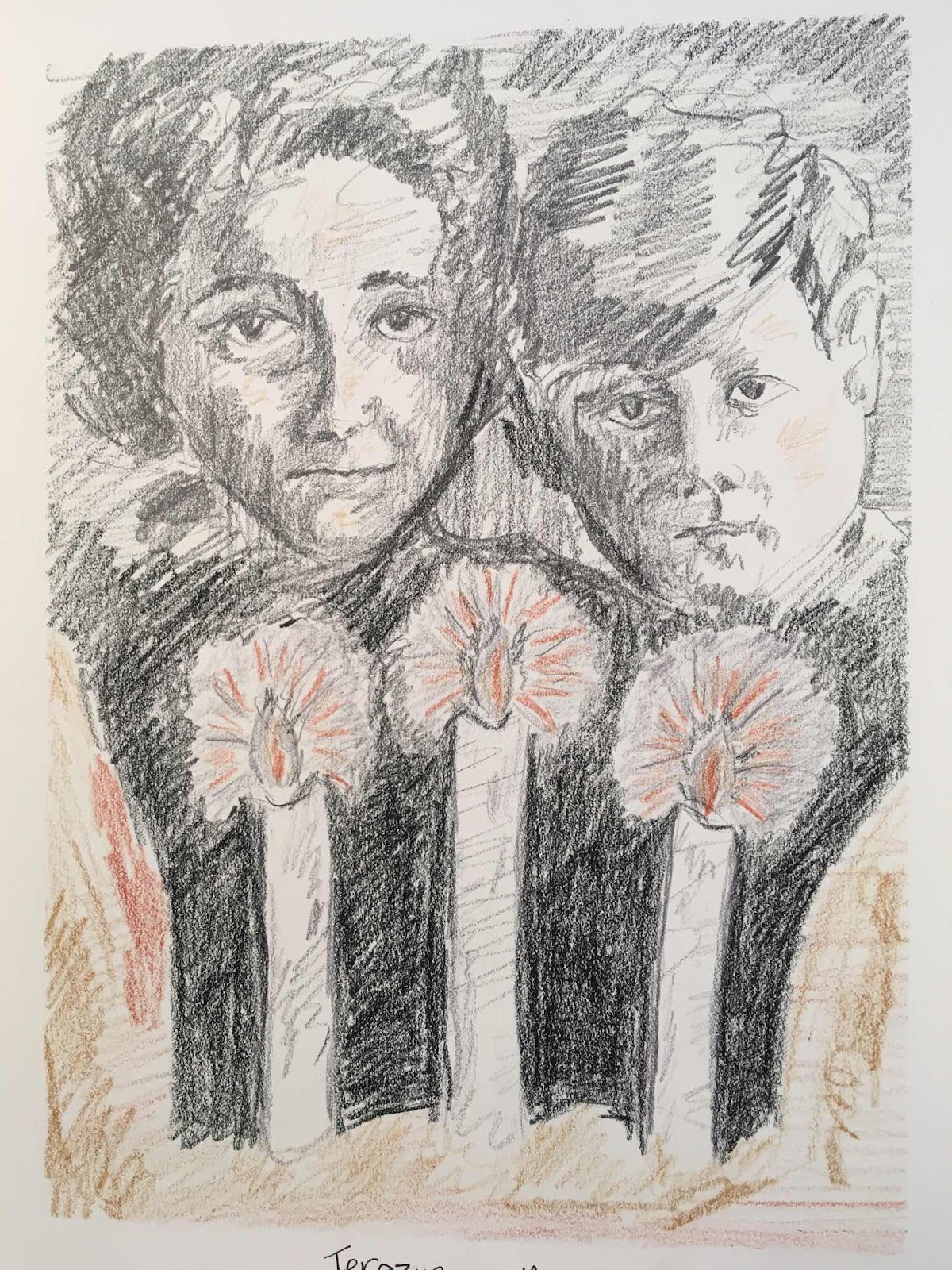
I also want to post her picture from Terezin. (Photo 5) I found it particularly moving because she combined the image of a young sister and brother who died in a death camp (from a photo at the museum) with an image of candles that came the crematorium where Jews were forced to burn the bodies of the dead, as there began to be so many people dying from disease and overcrowding that it was no longer possible to bury them. They were burned and their ashes were dumped into the river. The candles were part of a larger effort to create sacred space and honor the dead. I was struck by a quote that said something like “Memory is a bridge from the graves of the victims to the future.” In most cases the victims had no grave but it was important to survivors and descendants to build the bridge anyway. I know it was important to me to pick up pebbles and place them on the anonymous grave markers as my way of honoring of Freud’s sisters, three of whom probably passed through Terezin and then were transported to death camps to die, one of whom probably died there. As I face my own aging I can imagine both their reluctance to leave Vienna and the only life they had known, and the horror of facing forced transport and death without dignity or kindness. Yet it is the death of young children that haunts me and I love that Judy combined these candles of honoring and remembrance with the faces of children whose lives were cut off when they were so young. I am particularly moved by their eyes in the drawing and the quality of their gaze - they look directly at me the viewer, and their gaze. Their eyes seem to say “Here we are. “
The Kafka museum was very dark with the exhibits being small pools of light. The shapes of spaces were sometimes odd and I found myself feeling a quality of fear and fascination that was similar to what I felt as a reader many years ago now when I read Kafka. There was a very old film showing parts of Prague when Kafka was an adult and I was mesmerized. Cars shared the roads - the same roads I had walked on to get there - with horse drawn carts and carriages. Women washed clothes in the river. I felt as if I really were traveling back to an earlier time. Later that day when we walked up to the castle Peter pointed out that road had been in the film. I realized this would be the castle that inspired Kafka’s novel The Castle.
In another area where they showed a film there were mirrors on both sides of the room creating that sense of reflections reflected in an infinite series, as when one tries on clothes in a mirrored dressing room. Judy commented that she didn’t stay long because she was uncomfortable with the woman beside her who kept watching her. I took a selfie of myself and my reflection and I think the expression on my face suggests that the museum created a mood that was truly Kafkaesque. (Photo 6)
The museum began the exhibits with a letter Kafka wrote to his father (but never gave to him) when - if I understood correctly - the father had asked the son why he was so afraid of him. They exhibits suggested an Oedipal interpretation of the letter but I didn’t hear or see enough to find that persuasive.
I did feel a strong pull to revisit Kafka. The one story I have returned to in recent years is The Penal Colony, a story that impacted me deeply in my 20s, but that to my surprise bore very little resemblance to the story I so vividly “remembered.” I just downloaded The Castle in kindle form onto my phone and hope to read it.
I was struck in the museum by Kafka’s love of a Yiddish theater group. The museum description said that he lived it because the actors combined creative passion with profound humility - what he regarded as the essence of the true artist. That came back to me during my drawing meditation when I was drawing the figure of the woman rising ever so slightly into her toes and then bowing down. It seemed like a posture of passion (that exploratory downward gaze, looking for hair ties as I interpreted it) and humility (that body bowed in submission to the truth of whatever is, whatever comes).
As I write that I think of the professor saying “Just say whatever comes into your mind, don’t censor anything. “ Analysis is the practical cultivation of passionate curiosity about the unknown combined with utter submission to the truth. I am also struck that in travel one can wander freely and explore possibilities in a way that resembles free association.
After the Kafka museum we headed for the castle. I was the only one with a European SIM card giving me access to google maps and gps because I had a cellular data plan. So I was the guide. But I wanted to find a route through parks and green spaces which the app tended not to give, nor could I tell ahead of time if I would find a way out at the other end or if I would have to backtrack. For myself alone that was fine I didn’t mind meandering. But there were four of us and it led to a lot of negotiating and pushing and pulling, interactions that lead me very quickly into social fatigue. Nevertheless the detours I chose led into some lovely gardens including an encounter with the albino peacock in photo 7.
The castle area and especially the church were architecturally breathtaking (photos 8 and 9) although frankly I was too socially exhausted to give them the open hearted attention they deserved.
So after the castle I let the others head for lunch and went off for a solo exploration of a little island in the river where I could hang out near trees and water, no cars, few people. I hope Photo 10 conveys a little of the relief I felt. It was like a long sigh being able to walk at my own pace, steer my own way without explanation or apology or negotiation, and escape the sound and smell of the city for the green breath of the trees and their solid calm still presence and the slow ripples behind the ducks in the water.
I am thinking of Freud as a very little boy moving from the country to the city. When I was a little girl I could not understand why my father couldn’t be a farmer instead of a professor - so I could live in the country. Oh I also want to show you another photo of the Freud hanging out sculpture. This is by tour mate Ben - who is also filming Chris and seems to be quite a pro with a camera. Photo 11 is a close up of the sculpture.
I am struck by the facial expression - the mouth reminds me of the jaw pain in his later life and the forehead suggests both concentration and suffering - and yet the left arm and shoulder look relaxed and there is a quality of resignation in the face, I think. What do you think?
The most compelling insight for me has been to think of “my Freud” - the imaginary presence who nonetheless feels quite real to me - and, he assures me, to himself. In the early years of our analysis when he was playing the analyst, calm and composed and above it all, while also keenly aware that he depended on his erratic and unpredictable patient (that would be me) for his very existence - he literally was dangling over the abyss. I could cast him back into oblivion by acting out the night negative transference and leaving the analysis without negotiation (you know how fatiguing I find it to have to negotiate anything - I’d rather be sitting alone with the trees watching the ducks paddle by ...)
One thing I forgot to tell you that Chris said in her lecture. It was when she was talking about how misleading the English translation of Freud was, how it took supple and ordinary language and turned it into reified technical terms - like the ego and Id and superego instead of the I, the it and the over-I. But what I really want to tell you is that she said Freud ending all of his books with an ellipsis...
Thanks for hanging in there (so to speak). See you on the trail.
Oh my I forgot to tell you that we celebrated Freud’s birthday as we have for at least 27 years, by reading his essay on Transience aloud. Just in case you want to read it (I really don’t think he will mind that you are a day or two late), you can find it at
My sister Judy was irritated by his blithe assertion that mourning comes to an end, and that the lost “objects” of our love can be “replaced” by new objects no less precious. I suspect he would have worded it more carefully had he written it after 1920 when his beloved daughter Sophie died at 27 (the same age at which Judy’s daughter died). But I think what he means is that there comes a time when we are able to find joy in and pour our love into new people or places or creative efforts. Not that we ever stop missing or remembering or feeling sad about the one(s) we have lost. In that sense they can never be replaced - and I think he knew that, and if he didn’t yet know it in 1915, I feel sure he did by 1920.

Thank you for sharing your beautifully crafted diary. I thoroughly enjoyed every reflection. I understand that sooner or later we step out of mourning but while in it, it seems like an impossibility.
ReplyDeleteBlessings, Shelley
Photo 6 is stunning. Thanks for sharing.
ReplyDelete