May 28 - June 2. Grinnell College Alumni College, Class of 1969 50th Reunion, and return to Seattle.
May 28- Jun 2. Tuesday May 28. Car to Littleton Colorado RTD station. Bus from Littleton RTD to Denver airport. Plane to Des Moines. Grinnell shuttle to Grinnell. Wednesday May 29. Grinnell Alumni College lectures on History of Slavery and Feminist literary criticism, and seminar on Goya’s Disasters of War prints and Victor’s Disasters of Peace prints.
Thursday May 30. Alumni College lectures on Politics of Climate change and the social/racial context of Shakespeare’s Othello and Verdi’s Otello.
Friday May 31. 50th reunion. Lecture on trustees response to student revolution. Outdoor picnic in evening.
Saturday June 1. 50th reunion. Alumni awards for commitment to social justice and service.
Saturday Jun 2. Shuttle to Des Moines. Flights to Chicago and from Chicago to Seattle. Shuttle (missed) to Anacortes ferry landing (so took a Lyft). Ferry to Orcas, drive home.
Dear Trail Friends,
Almost as soon as I begin this post I will have to interrupt to go to a group photo session for our 50th reunion.
I have been so overwhelmed by people - strangers who occasionally remember me and who I rarely remember, but with whom I shared those tumultuous years 1965 - 1969 on this little campus (with its history and culture of commitment to the liberal arts and social justice).
I have not been able to imagine blogging - just swept away in the flood of experience and not able to stand on solid ground and get perspective and distance. I want to begin to do so by sharing a poem by Walt Whitman from the Writer’s Almanac (which has begun to appear daily again after two years of interruption following Garrison Keillor’s having been accused of sexual harassment.)
Articulating my ambivalent feelings (and thoughts) about the disappearance and the reappearance of the Writer’s Almanac, and the dilemmas raised by the “me too” movement in general (how to ensure justice to both accused and accuser with crimes with no witness? how to hold a person accountable for his crimes in a way that emphasizes rehab rather than revenge? how to condemn the crime without erasing what is valuable in the individual’s contributions to culture? ) would require a whole long post, and way more energy and time than I want to give to them right now.
But here is the poem, (and I am very grateful to have received it.)
Out of the rolling ocean the crowd
by Walt Whitman
Out of the rolling ocean the crowd came a drop gently
to me,
Whispering, I love you, before long I die,
I have travell'd a long way merely to look on you to
touch you,
For I could not die till I once look'd on you,
For I fear'd I might afterward lose you.
Now we have met, we have look'd, we are safe,
Return in peace to the ocean my love,
I too am part of that ocean, my love, we are not so
much separated,
Behold the great rondure, the cohesion of all, how
perfect!
But as for me, for you, the irresistible sea is to separate
us,
As for an hour carrying us diverse, yet cannot carry us
diverse forever;
Be not impatient — a little space — know you I salute
the air, the ocean and the land,
Every day at sundown for your dear sake, my love.
***
I was sitting in the dining hall this morning - deliberately sitting alone, at a small table by a window (photo 1), looking out on the green lawn (and construction activity - the campus is very much under construction.)
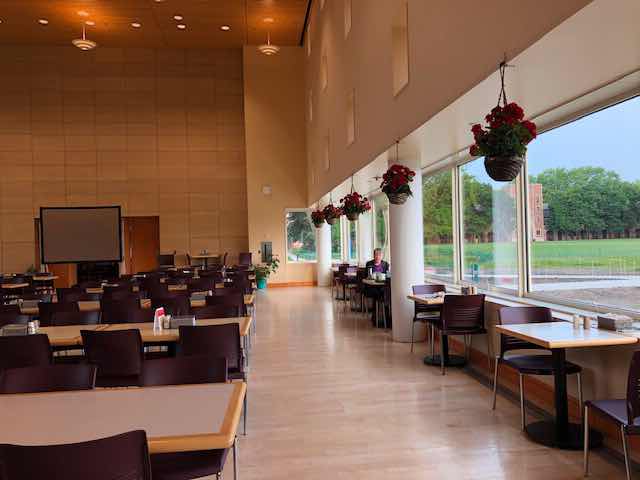
I listened to the “roar” of the crowd in the dining hall (I know all the people don’t show in the photo but believe me I could hear them!) and I tried to imagine the human-crowd-sound as an ocean, and to observe my fear of it - fear of being drowned in it, fear of its presence beside me, fear of separation from it.
I was longing for that poetic intimate contact with a single other “drop” yet feeling my fear of such contact and keenly aware of how I fear the transience and imperfection of all contact. (Including contact with myself, and writing this blog in which I try to become that “drop” in relation to you.)
I’ve been observing, during this reunion, how painful human contact is (for me) when it falls short of attunement. This hypersensitivity makes me wonder if I have a kind of “perfect pitch” for intimate attunement and can’t tolerate the normal dissonance of human encounter. I feel that I don’t know much about how to come into tune with people - I either get there by accident (like falling in love) or I experience the disharmony between us as unbearably abrasive, and feel helpless to transform it, and frantic to escape.
On the other hand...(or on one of several other hands)...when I got on the shuttle from Des Moines airport to the college I sat beside a woman probably in her 40s or so. We slipped almost immediately into deep and intimate conversation. I no longer recall the content and I fear it might be too private to share - oh but I do remember! She confided two major life passages - a breakup with a man she was engaged to, and the end of a career (teaching yoga and meditation, dealing with the transference involved in being a spiritual teacher) and the beginning of another career (jazz piano). Each life passage was made possible (and necessary) by a health crisis, one of which was in her view entirely psychosomatic, both of which allowed her body to lead her where she needed to go.
This harkened back (for me) to the Freud tour and my beloved professor’s theoretical insistence on the primacy of the body - that the deep truths of our nature are embedded in our bodies, and cannot be transcended (at best sublimated). As I write that I wonder why I think there is so much diffference between the two. Transcendence I think refers to experience beyond the physical, while sublimation is taking something physical and transforming it into something else - also physical. To transcend (etymologically) is to climb beyond. (I associate it to a painting I’ve seen of a ladder, like Jacob’s ladder, but hanging in the air above the earth with only air below it, and only air above it). To sublimate is to change from a solid into a gaseous state - a state involving more molecular freedom and movement, but no less physical for that. Not sure what makes them (transcendence and sublimation) so different on a practical level. Then I think of Chris saying “you don’t have to choose between Jung and Freud. You can learn from both of them.” I don’t need to set up transcendence and sublimation as adversaries (I find myself picturing the drawing I did of death and Eros, inspired by the brothers sculpture. Two struggling bodies. One shared head.)
I am sad I have almost no photos to share. I think it is problematic that the alumni college experience is so relatively disembodied for me. Sitting in a lecture room relating almost exclusively to ideas. Almost no sensory component other than the body’s restless need to get out of the chair and pace at the back of the room. I find it really hard to blog because I can’t find the physical part of the experience, and even though I let my mind associate freely, I’m used to having an anchor in a physical place and experience when I blog.
There’s a photo in the beautiful memory book that some of my classmates put together of me and two classmates at the baccalaureate gathering just before our graduation. I think we were all three baccalaureate speakers. I remember that my speech was very critical of Grinnell for carrying on a tradition that taught ideas in a vacuum - without engaging body, hands, emotions, senses, and so estranging the student-thinkers from their own embodied selves, as well as from the (working class) physical workers around them. (I was very much influenced by Marx at that time in my life.)
I think part of why I find this gathering so indigestible is that I don’t know how to engage my body. And yet ... there are dancing activities, yoga, offered, and I do not attend them. Just as 50 years ago there were sports, theatre, arts, music - these were core to many of my classmates’ experience of Grinnell. Many of them also did physical work on the campus. It was my own very unique experience of Grinnell, my personal focus of attention (not the college as a whole), that was cut off from the physical.
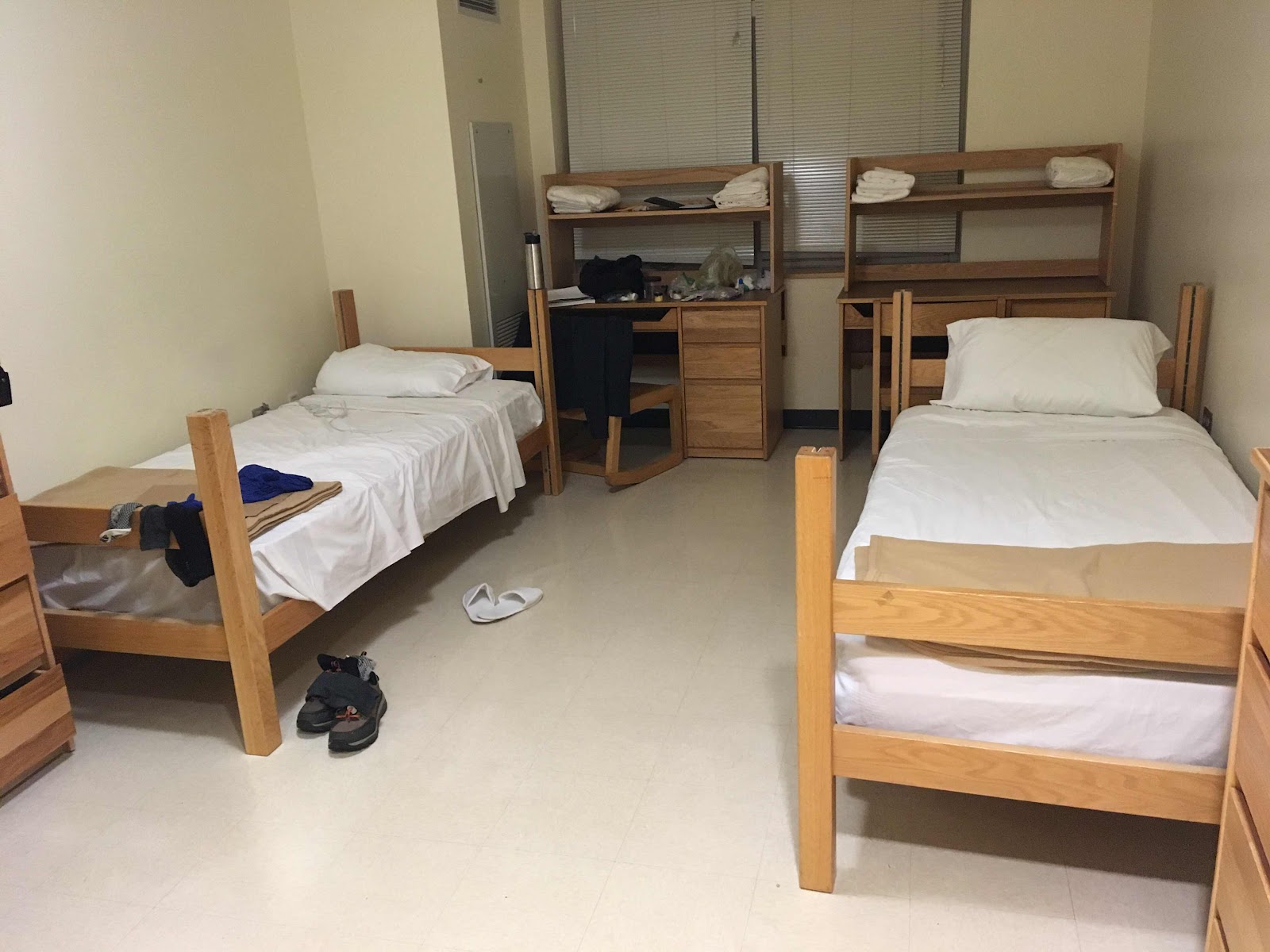
I do have a photo (photo 2) of the room I am sharing with my former roommate Mary Zick. (It was taken before her arrival)
One thing I love about the reunion is the laughter. Mary Zick and I remember the year when we presented “Mother Earth” as a candidate for president of the associated women students. We made signs like “her opposition is groundless” and “she has Burling Library surrounded” and “ ‘I will bury you’ says Mother Earth.”
Mary and I went to visit the basement of Cleveland Hall where we were roommates in our sophomore year. We walked into the bathroom and heard the sound of a toilet running. “Are you okay?” Mary asked the toilet. (The toilet didn’t answer.)
Here is Mary Z in photo 3.
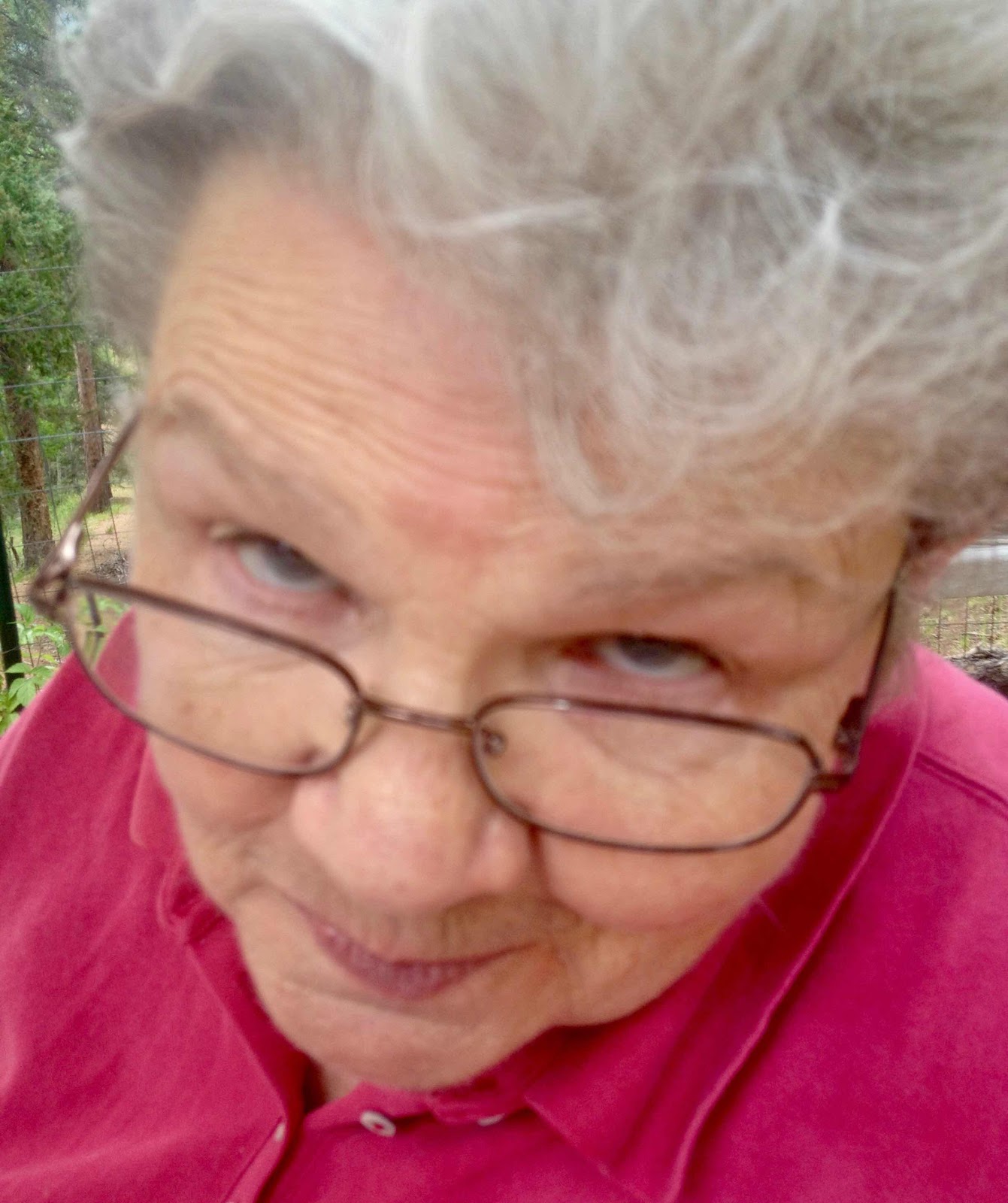
She is having fun being a grandmother (like me she is a grandmother through her partner) and I can imagine the merry mischief she instigates with her grandchildren.
She asked her five year old granddaughter what she should say to people at the reunion. Just say “I love you. Will you marry me?” the child suggested. Or, she added, say “I missed you.” Mary told this story and soon attendees of the reunion were saying to Mary and one another “I love you. Will you marry me?” and responding “I missed you.”
But back to my arrival at Grinnell. Another eerie connection with the Freud tour was going out to dinner with a woman both of whose parents left Vienna after Freud did (and whose grandfather was caught trying to escape, then deported and murdered in a camp.) Her parents would have been 8 and 10 when they left, like so many of the children whose drawings I saw at Terezin. Her story vibrated in my body and soul throughout the reunion, and set the stage for me to consider how the political world intersects with our personal stories.
Much of the weekend was about how it affected all of us (each differently) to come of age at a time when our faith in a mythical America (“home of the brave and the free,” “with liberty and justice for all,” “give me your poor, your tired, your huddled masses learning to breathe free”) was shattered. During the Vietnam War and the civil rights movement, the national denial - both of the brutality of slavery and post-slavery racism, and of the economic-political-military domination and exploitation of poorer countries - began to be seriously challenged. As young people at a college deeply committed to social justice and service, we as a cohort were wide awake to those changes. We were shocked and profoundly shaken.
I was so exhausted by those really deep and for me very valuable soul-touching conversations (on the shuttle and at dinner the evening I arrived) that I could barely walk through the first day of Alumni College. But I did.
I am not going to go into details of how deeply the lectures touched me (or the prints in the print collection). The prints in Goya’s Disasters of War series raised the question of what it means to witness human cruelty and suffering. There were so many different ways of witnessing in the prints: turning one’s back, looking on with seeming indifference, moving corpses as heavy physical burdens with no apparent emotional engagement, offering a cup when a cup is too late or not enough, touching the ill when contagion is a risk, going about one’s own life at a distance ...
One of the prints that moved me most was titled Sanos y Enfermos (Healthy and Sick, Photo 4). The emotional impact for me came from the hands touching - what I saw as a well woman risking touching the sick - with compassion, contrasted with women to the right going about their business - I imagined their hands involved in buying or selling, counting money. This was part of a subset of the prints that portrayed the post-war famine and plague (after Napoleon’s invasion of Spain.)

I found the print on the internet, and I hope it’s high enough resolution for you to see. Can you see the hands of the cloaked woman near the center? One hand is holding the shoulder of a child who leans into her, one hanf seems to gently stroke (with the back of the fingers) the cheek and hair of a mother holding a child.
The visual impact of these prints helped me engage more deeply with the lectures. It made the more verbal and intellectual content of the lecture on how to teach slavery come alive because human suffering was present to me in a sensory way not just through language.
I found myself having a big sobbing spell about the fact that my own ancestors were slave ship captains. I imagined my ancestors packing people tightly into the ship to make the voyage as profitable as possible. I tried to imagine what it might mean for me, to live with that moral legacy.
There was a strong sense of time warp during the reunion. Present and past time, my 71 year old and my 22 year old self, both were present and also not present. The campus itself was s strangely disconcerting combination of old buildings that evoked body familiarity and former times, and large modern buildings assertively reminding me that the past is no more. The “forum” - a new and modern building in 1964 - that included a cafe and rooms for meetings (including most of our political gatherings) and dances - kept surprising me. Each time I passed it I felt a physical pull to enter. The doors were locked when I tried them. The rooms had all been repurposed as administrative offices. My eyes surprised me by filling with tears.
Once during the reunion I saw six or eight vultures circling, settling into, and lifting off from, a campus tree. I found myself gazing around, wondering what carcass might be attracting so many vultures. I decided they were circling over the (invisible) carcass of the past, so palpably present and yet so irretrievably gone.
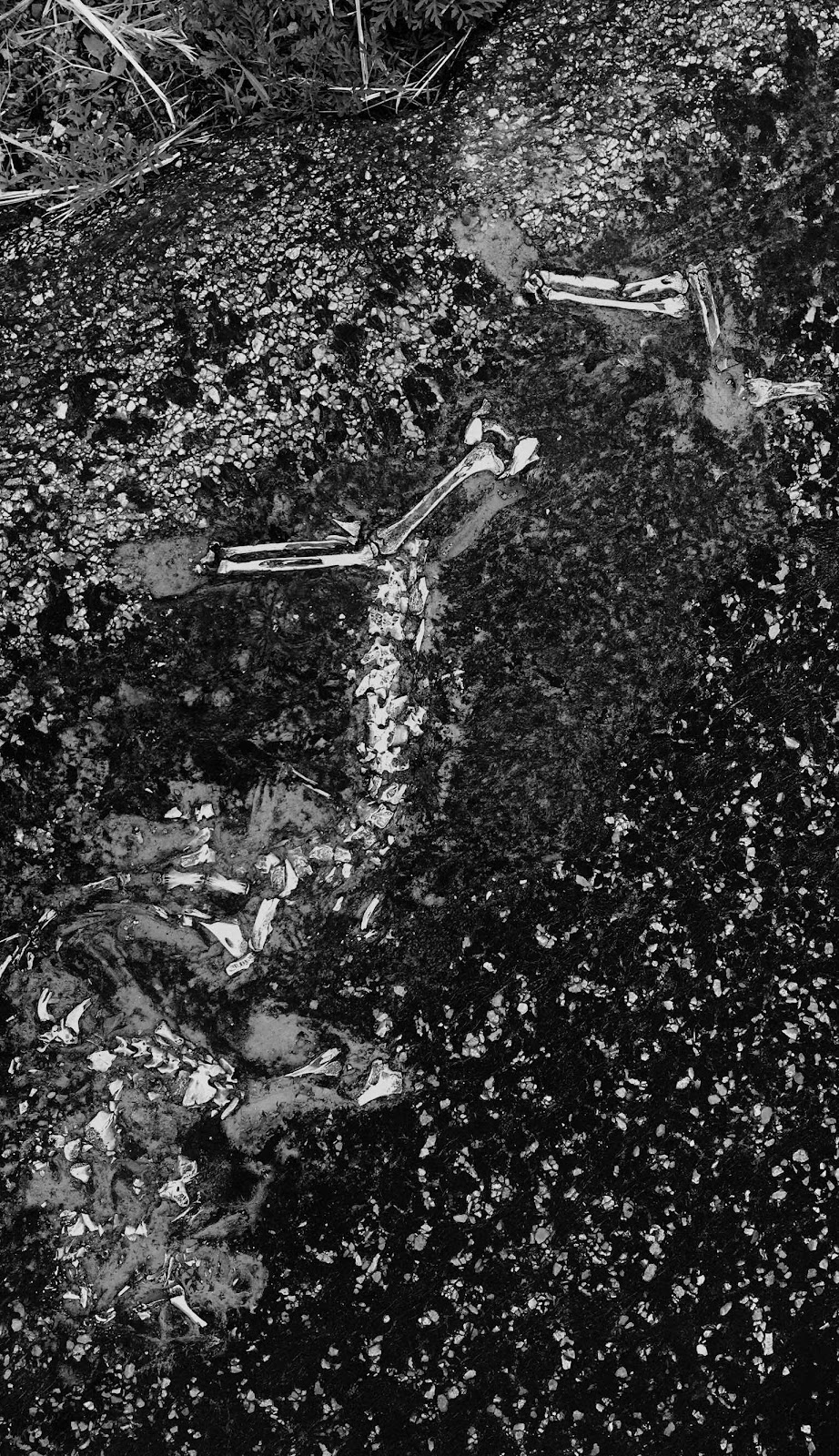
On a walk Saturday morning I came across the dead body of a raccoon and photographed it. Later I saw some remnants of bone embedded in the tarmac of the road. Both intrigued me because they were visual representations of something that had once been alive but was gone, but still parts of it lingered. (Photos 4 and 5).
Several times people greeted me as “Molly” and I felt a ghostly former self stir. My friends had started to call me Molly in the fall of my freshman year, 1964 (after I had confided that Molly was my secret name for my innermost self).
I continued to be called Molly until about 10 years later, when in the midst of the emotional and mental upheavals that followed my dropping out of MIT, the inner powers that be renamed me River during an acid trip.
Actually, I went by “Little Woods Woman” for about 6 months before that, after a scary experience at a small pond (not far from Walden Pond) where people swam nude. I had wandered off alone (nude) into the surrounding woods, followed by a group of teenage boys who started to goad and challenge each other. “Shall we jump her?” “What’s wrong, are you chicken?”
Their threatening presence intruded on my trance-fantasy, in which I was following my imaginary pregnant goat Moonshine (my imaginary guide) through the woods toward a field of melons. After my goat guide led me to the place, and as she was crying out and giving birth, the boys were kicking a melon into jagged fragments.
As I write about this now, all these years later (and these are not easy memories for me to revisit) I am struck how the imagery (of my slightly deranged imagination in a slightly deranged world) is emblematic of two central themes in my life. The first is the theme of motherhood (or lack thereof) and the second is the theme of human brutality toward other humans (rape, war, slavery/racism).
That day - standing naked at the edge of the woods, beside a field of melons - I became profoundly frightened. My trusted (though imaginary) guide seemed suddenly vulnerable. The boys, young though they were, seemed dangerous. I found myself praying to the woods around me, calling on them to guide and protect me. The trees seemed to surround me with protective care, and to guide me off the main path onto a narrow path leading further away from the lake. Luckily the boys did not follow me.
Later, in yet another trance experience, I imagined the Native American leader Crazy Horse guiding me through a healing ceremony and re-naming me Little Woods Woman. The name meant “Little Woman Lost in a Big Woods.” It was meant to commemorate and reinforce my learning to trust the woods, to trust in something bigger and wiser than myself. (I had been experiencing a spiritual opening in which I had an inflated sense of my godlike powers to manifest my thoughts as reality, based in part on the spiritual teachings of an imagined spirit teacher, a murdered woman named Marge who had been a psychic and teacher, and who I imagined had contacted me after her death to pass on her wisdom. As I think about now, her having been murdered did not come as a strong recommendation that she could create the universe the way she wanted it with her godlike thoughts. Someday, as part of my life integration path, I will reread those journals and see what I can make of them. Meanwhile, this experience in the woods humbled me, and helped me relabel my spiritual breakthrough as a mental breakdown, which helped me to eventually end my relationship with Marge and make my way slowly backs to a more consensual reality.
But back to the 21 year old Molly - I think my sense of the presence of my younger self - my dual awareness of her as both dead and gone, and as a ghostly presence evoked by the reunion place and people - was part of what made the experience so intense. Mary Zick said she thought she had come to the reunion to pick up some lost pieces of her soul.
Who was Molly and who is she to me now?
Vivid memories collide. I am walking across central campus at night after seeing Felix Greene’s film Inside North Vietnam. I have just watched footage of bombs falling on civilians, of mothers running away with babies in their arms, small children running away and screaming, some escaping, some being killed. The images are seared into my imagination. As I cross campus someone tells me that American cities are burning. It is the day after Martin Luther King’s murder. The anger of blacks in the cities seems inseparable from the running and screaming mothers and children in the film, and from the history of slavery and the brutal treatment of families during and after enslavement. I am waking up to my country’s (my ancestors, my own) shadow side and I am horrified. I walk to a park, curl up into the hollow of a tree, sob and pray that I can contribute to the healing, and not to the harm we humans inflict on each other.
Another memory: Students for a Democratic Society, guerilla theater and Women’s Liberation all gather at Henry Wilhelm’s off-campus house. The college has invited a representative of Playboy Magazine to speak (as part of the college sex education lecture series) and we have gathered to plan a protest. Several people have pointed out that our protest could easily be misunderstood as a little midwestern Christian college protesting the playboy philosophy of sexual freedom. What we want to protest is the commercialization of sex and the depersonalization and commodification of women’s bodies. The guerilla theater people suggest some women go semi-nude and paint their bodies with cuts and prices like pieces of meat.
We discuss nudity as a strategy. Would it be effective? Would it alienate our audience? We are consciously planning our protest for a larger public audience who will hear of it through the news. We want to open minds and hearts. We argue intellectually, trained as we are in abstracting our thought from our bodies and feelings, totally unaware of what we might each be feeling about the possibility of exposing our own naked, imperfect, and vulnerable body to public view.
Then Fredricka Nelson, an art major, quietly takes off her clothes. My consciousness drops from my forehead straight down to my gut. I want to protect her, to wrap a blanket around her. I am aware of her as a person, a beautiful vulnerable presence. For me it is an epiphany, as I think it is for others.
We plan a silent protest, a disrobing. In the end we agree to a distributing a leaflet (which I will write, titled “Playboy Magazine is a money changer in the temple of the body”) and singing a song (You’ve got to walk that lonesome valley).
I cannot tell you how terrified I was as the protest approached. I wondered if my professors and others would ever respect me again after I exposed my nakedness.
Our subsequent arrest (for conspiracy to commit a crime), our defense by ACLU (who saw our action as a form of free speech), the trial (during the week before graduation) and our conviction for indecent exposure (despite the fact that the law requires lewdness and no one testified to lewdness), the appeals to the state and federal supreme courts (the former upholding the decision, to my shock, and the latter refusing to hear the case), the letters I received from Christians who saw me as a representative of the devil - all of it comes back with the force of experience that was too big for me to digest and assimilate at the time.
But several people approach me at the reunion to tell me that my actions (I infer the Playboy Protest, although there were many other actions by groups I was part of) affected their lives, made them think and question, helped shape who they became - that I was a part of their Grinnell education. These people have lived lives quietly committed to social justice and service, something I was not able to do in the wake of my dramatic risks and consequences. I like the idea that I helped to plant seeds in others that bore fruit, that I was a small part of what made possible their good work in the world.
Pictures. We need pictures to anchor this swirl of memories and associations. Walking alone just a short way from campus, I walk among newly planted cornfields, the gentle curves of the prairie, a red winged blackbird, a pond and a barn, the fragrance of lilacs. (Photo 7).
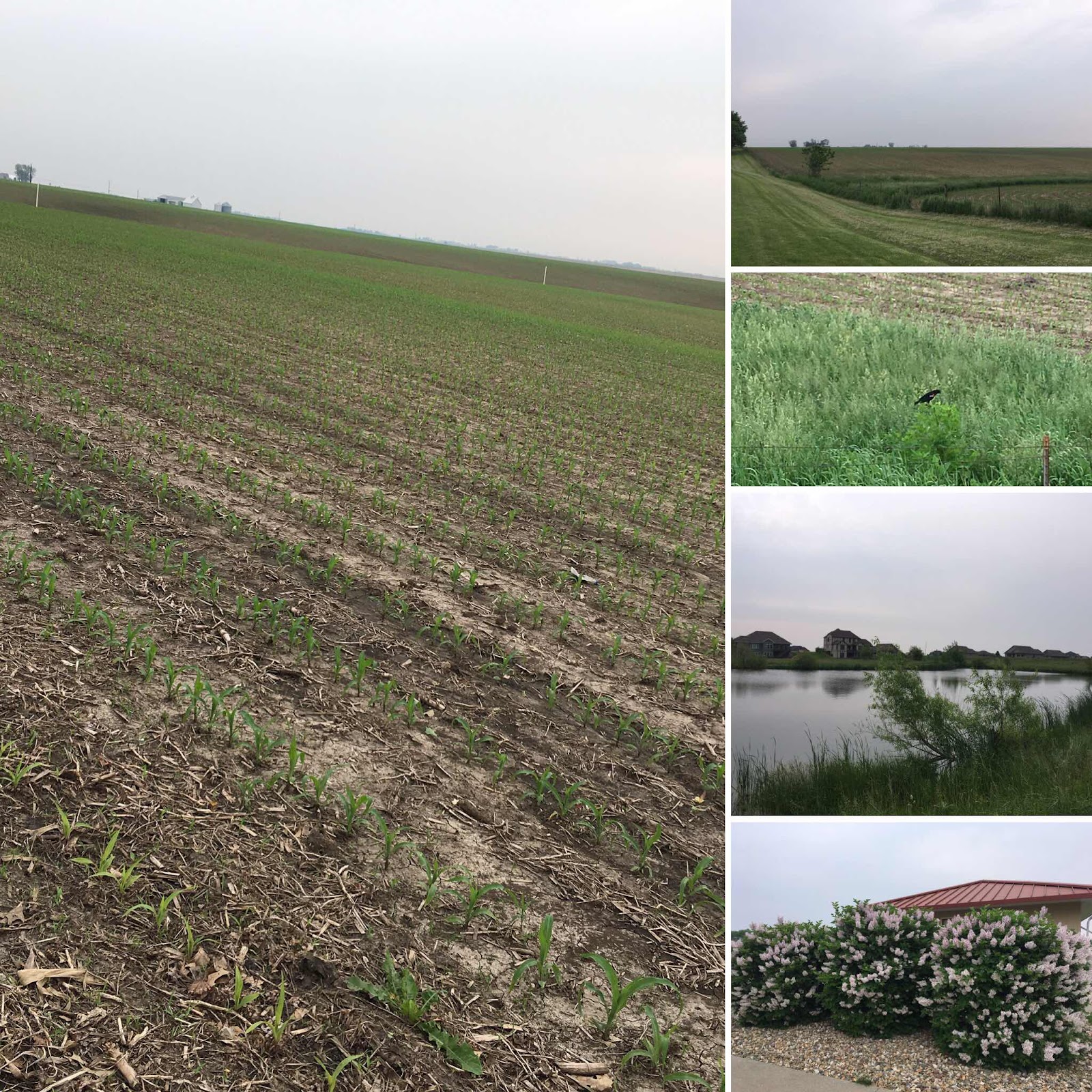
The earth soothed and held me then when I was a young woman, as it does now when I have grown old. I know I cannot write coherently about all that has been stirred up. I am grateful for the sense that I shared those times with others, more perhaps than I realized at the time, that we were shaped by this place and the times and each other.
Former Grinnell President Drake talks to us about the founding of Grinnell by Evangelical Congregationalists who were also Abolitionists. He tells us about the evolving emphasis on the social gospel, the growing emphasis less on the crucifixion story and more on the living Jesus, and his care for the weak and the poor and the disenfranchised. He speaks of the school’s ever-growing commitment to social justice. He speaks of the war in Vietnam, the young men expecting to be drafted into what appeared to many of the students to be an unjust war. He speaks of the civil rights movement, and of Martin Luther King’s visit to the campus a year and a half before his death. He speaks of women locked in their dorms at night, the college’s role “in loco parentis,” the student power demands for co-ed dorms, for a voice in curriculum.
He tells a story of the Grinnell trustee of over 40 years (Joe Rosenfield, for whom the building we meet in was named). Rosenfield addressed the fierce polarization between the trustees who were committed to listening to and learning from the students, and the trustees who were determined to protect students (and the college) by maintaining the parental role. “I’m willing to vote for co-ed dorms,” Joe said “but only if we make them retroactive.” Everyone laughed and their shared laughter broke the tension and opened the way to negotiation. Coed dorms began during our senior year.
My dear trail friends, you can see that I am wandering around, tangled up in the threads of these memories. I’m reminded of a prank when we covered central campus with a web of string between trees with balloons attached so people had to step over and crawl under the many intersecting strands to make their way across campus. We had asked for permission, the dean had said no, and we did it anyway. I believe we mocked her, comparing her objections to the Cold War “domino theory” used to justify the Vietnam War. “First it will be string and balloons,” we imagined her saying, “and the next thing we know you will have covered the campus with barbed wire and blimps.”
I find the memory of our youthful exuberance refreshing, but wince at former President Drake’s description of how he was treated by student activists. “I was part of the establishment,” he said. “I was a non-person. I was part of the same establishment that was responsible for racism and the war in Vietnam.”
This regret is not new. I came to understand the effects of how student activists treated military recruiters (often peers doing their duty as they understood it, and usually with fewer options and privileges than we activists had) and I was filled with remorse. I met a woman who went to a campus as a recruiter and had a pail of blood thrown on her by protestors. She developed rheumatoid arthritis soon afterward, and the intense stress may well have triggered the condition.
I have listened to people who served in Vietnam and were “welcomed” home with dislike and disrespect. When I meet a person who has served or is serving in the armed forces, I try to make a point of thanking them. I almost always find my eyes fill with tears when I do so. I imagine their risks, and the risks of the young people who went to Vietnam.
Life is not simple. Sometimes I think my moral compass is even more disturbed than my directional compass. I have never been able to find the needle that points to the true north and clearly distinguishes right from wrong.
I left social activism after a sense of helplessness and hopelessness led me (along with others in SDS, Students for a Democratic Society) to question nonviolence. Didn’t we have to combat the brutal force of the rich and powerful with opposing force? Shortly after I left Madison Wisconsin (where I briefly was in graduate school in math, after graduating from Grinnell) a bomb was planted in the Army Math Research Center. I saw that research center as culpable - they developed theory there that made possible ever more powerful weapons that brutalized human beings in unjust wars. I could have easily been among those who planned and planted that bomb. A graduate student, the father of young children, was killed by the bomb. I was stricken by how close I had come to adding dramatically to the brutality rather than helping to heal it. This was one of the turning points, one of the moments of truth, that led to the series of mental meltdowns in which Molly became Little Woods Woman and Little Woods Woman became River.
We could use a little comic relief right now but in lieu of humor, let’s try photographs. Train tracks run through Grinnell Campus, separating what once were the men’s dorms on North campus from the women’s dorms on South campus. Trains used to pass through and we students sometimes climbed through train cars to get to class when the trains paused. As I walked on the tracks, I saw metal parts broken off and lying along the gravel. The neglect suggests that trains no longer run on these tracks. Photo 8 shows the loose metal pieces and photo 9 shows a sunset behind the tracks (just part of my meditation on change and time present and past).

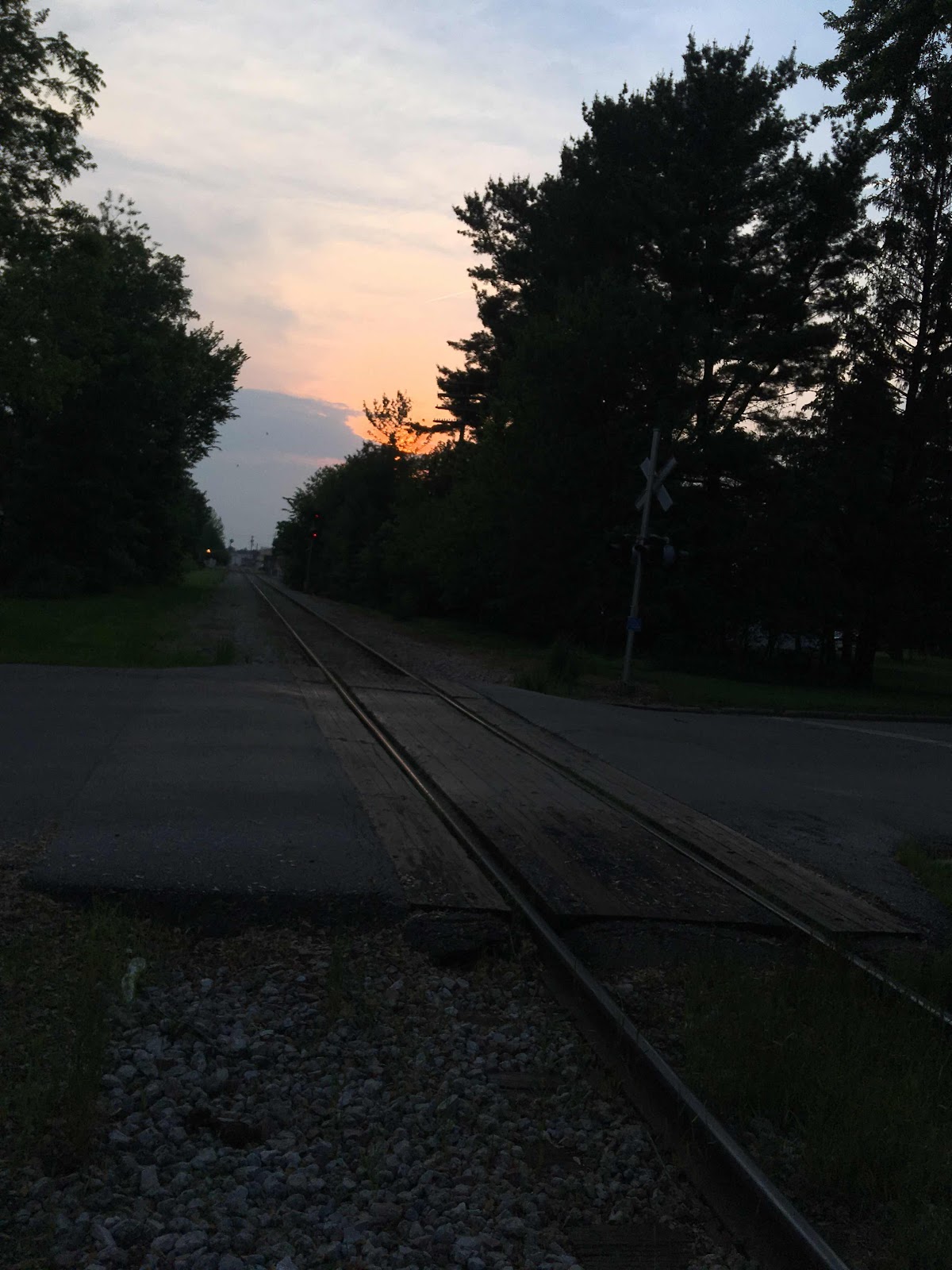
I dreamed of trains and tracks often as a young woman. They seemed to symbolize conscious goals, paths into the future that were clearly mapped out by authorities, collective wisdom, and institutions, as over against the zig zag meandering path my life followed responding to my own deep inner leadings (and my impulsiveness, and opposition to authority).
Now I associate the tracks with the strict barrier between the genders and the traditional rules and roles that defined what it meant to be a woman or a man. Not that those rules and roles were all that clear or explicit but the reality that we girls were locked up in our dorm is a potent symbol of those norms. Mary Zick and I visited the Stonewall Center on campus that offers support to GLBTQIA students (I think that is gay lesbian bi trans queer intersex and allies, but I’m not sure). A young man told us some of the history of the center (beginning in 1972, three years after our graduation, with an anonymous letter to the editor of the college paper, challenging homophobia and requesting contact and community with other gays through confidential contact to be arranged by the chaplain). I was fascinated and moved by the courage of the anonymous letter writer. Also at the Stonewall Center, I witnessed a conversation between a Grinnell graduate, a mother whose FTM trans son was about to start college, and the young man from the center, along with two FTM Grinnell undergrads offering their experience and wisdom. It was the first time I have ever thought about trans people and felt wholly open and curious, free of attachment to the firner gender constancies (however much I wrestled against them, they also connected me with a kind of mystical devotion to the physical and biological that is hard for me to yield. Perhaps it’s a form of certainty I’ve been unable and unwilling to give up. The facts of breasts, menstruation, even infertility came from a deep truth in my physical being that I hold as sacred. I get anxious when people want to change that with hormones or surgery.) But for a moment at Grinnell I was free of all that. Free to listen with respect and curiosity to people who were simply different from me in their relationship with the biological givens of the body and gender.
I have been thinking about Grinell and gratitude. What were Grinnell’s gifts to me? I was so oppositional in my youth, I fought against Grinnell. It’s easy to appreciate individual faculty and students who were kind to me, who saw me, cared, responded, encouraged. Those are clearly gifts. But that moment in the Stonewall Center was another gift. That moment of being able to see an “other” as simply other. Not to need to argue with them. To observe them with curiosity and, yes, with gratitude.
One of our class who is a minister had the hutzpah to talk about God in our so very secular culture, and to offer a prayer before our closing dinner, a quote from Dag Hammarksjold that went something like this:
“For all that has been - Thanks. For all that shall be - yes.”
I’m grateful to Grinnell for that reunion classmate having the guts to start our class dinner with that prayer. I’m grateful for the moment of yes in the Stonewall Center. (It makes me think of course of the great literary yes of Molly Bloom and if I weren’t on an airplane without WiFi I would look it up and copy it here for you and I may later).
So here it is (inserted almost a week later as I try to muster the courage to post this beautiful mess. I read Ulysses in high school and I am sure Molly Bloom - along with my paternal grandmother Molly and the fact that my father had wanted to name me Molly - helped inspire Molly as my secret name for my true self. It’s the name I also gave to my first adult dog-love, the Irish setter and golden retriever puppy that my young friend Sharon adopted just before she died. )
I was a Flower of the mountain yes when I put the rose in my hair like the Andalusian girls used or shall I wear a red yes and how he kissed me under the Moorish Wall and I thought well as well him as another and then I asked him with my eyes to ask again yes and then he asked me would I yes to say yes my mountain flower and first I put my arms around him yes and drew him down to me so he could feel my breasts all perfume yes and his heart was going like mad and yes I said yes I will Yes.
Meanwhile, back to the tracks that used to divide north (men) from south (women) campus. The new modern dorm where most of our class was housed had two restrooms on our floor. During alumni college there were no gender signs posted and with some anxiety I used the nearest one. (I had used mixed gender restrooms often in Spain on the Camino, but at Grinnell in my day the other gender lived on the other side of the track. Actually, according to our speaker coed dorms began my senior year but I lived off campus that year and do not remember experiencing them). But after the Alumni College Days, once the reunion officially began, someone posted “MEN” on the restroom next door to me, and “WOMEN” on the restroom at the far end of the hall. I ran into a make classmate from the far end of the hall in the same predicament as me, and we had a lot of fun adding women to the men sign and men to the women sign (photo 9).
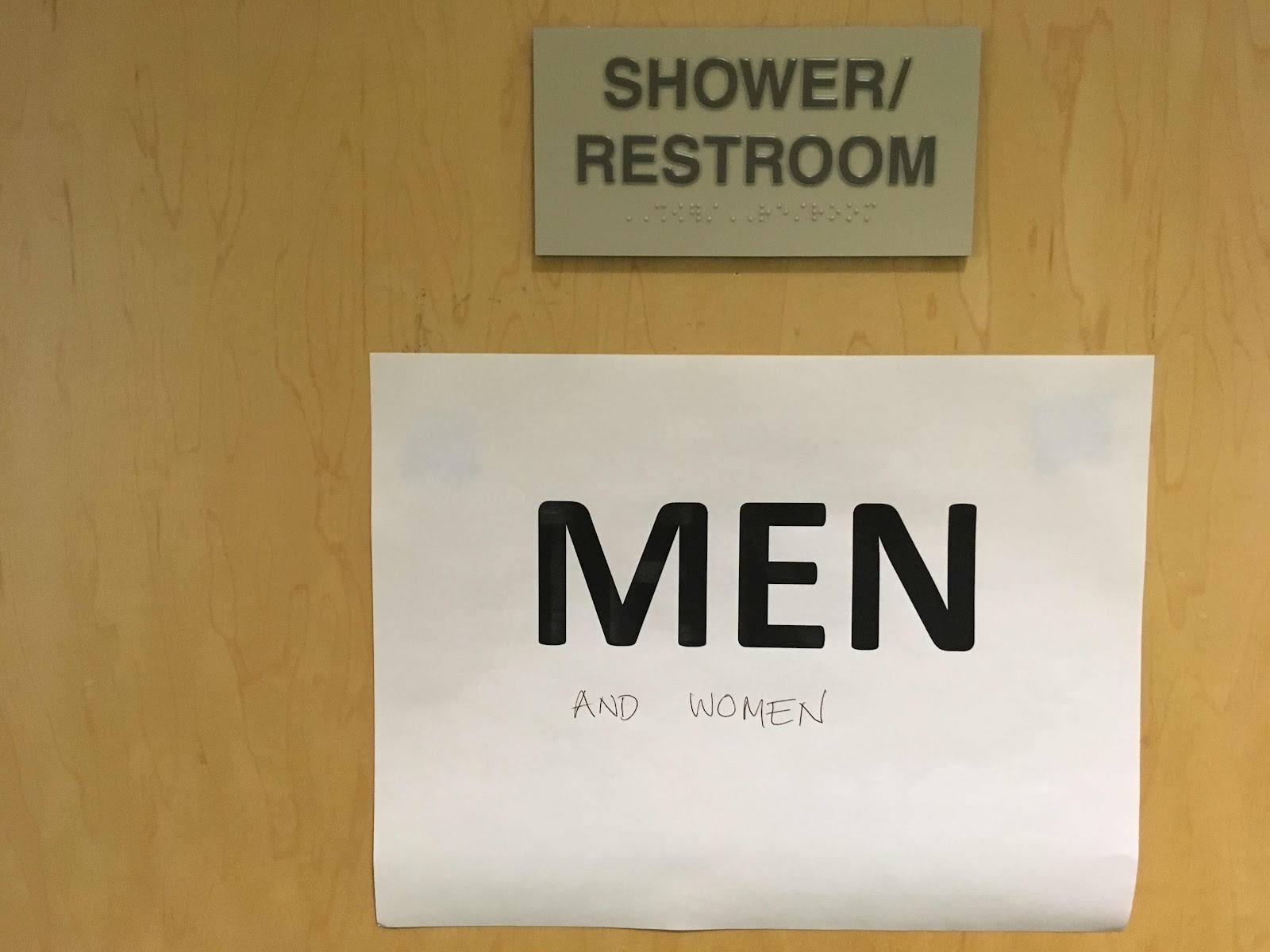
I screwed up my courage and used it, but I did feel nervous when I heard other people in the restroom with me? fearful my presence might embarrass both of us. Nevertheless, I went on using it.
Okay. So there’s more. There’s a lot more. But I’m tired of writing. There’s no way I’m going to wrap this all up. No way to unify this post much less relate it to the whole trip before during and after the Freud tour.
So let me end with the usual gratitude. Thank you for walking with me and giving me the opportunity for this deep reflection I could not possibly host without the idea that you are invited to the party. Thank you for braving the chaos with me and searching for moments of understanding (and gratitude). It’s been a wonderful journey and I know I will be living with the echoes and resonances for weeks and months to come. Who knows, maybe I will even post again.
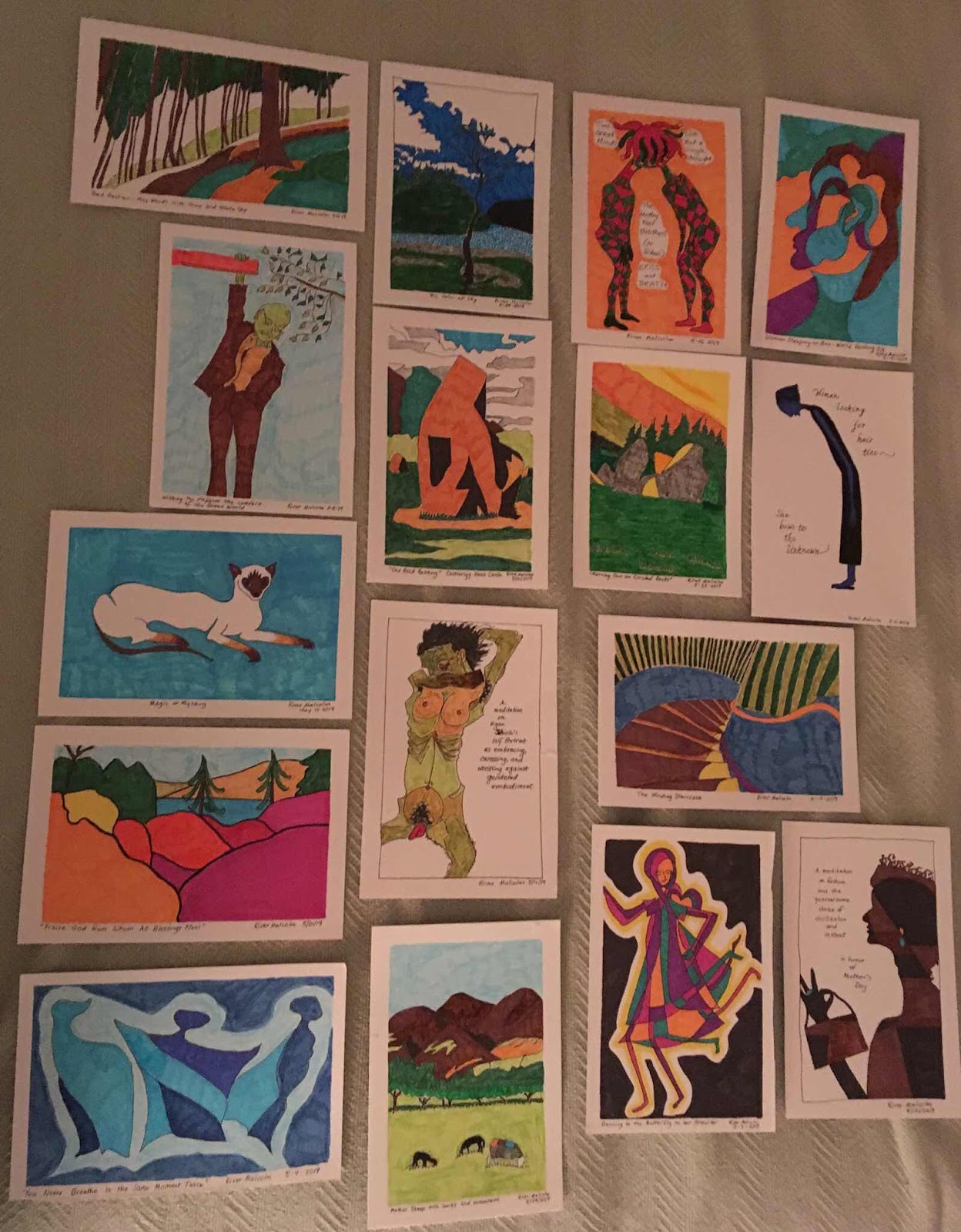
In the meantime, I think I will conclude, here in the air between Chicago O’Hare (where I flew to from Des Moines) and Seattle, with photos 10 and 11. Judy and I were too tired our last night in London to draw, or to spread out our drawings from the whole trip together and look at them. So we spread them out separately and here they are. See you on the trail (someday, somewhere) and thank you with all my heart for walking with me.



Comments
Post a Comment